

23/10/2025 20:38 PM
Beyond Tyranny:
A Case for Geographical Federalism in a Post-PFDJ Eritrea
by Dr. Negassi Hadgu
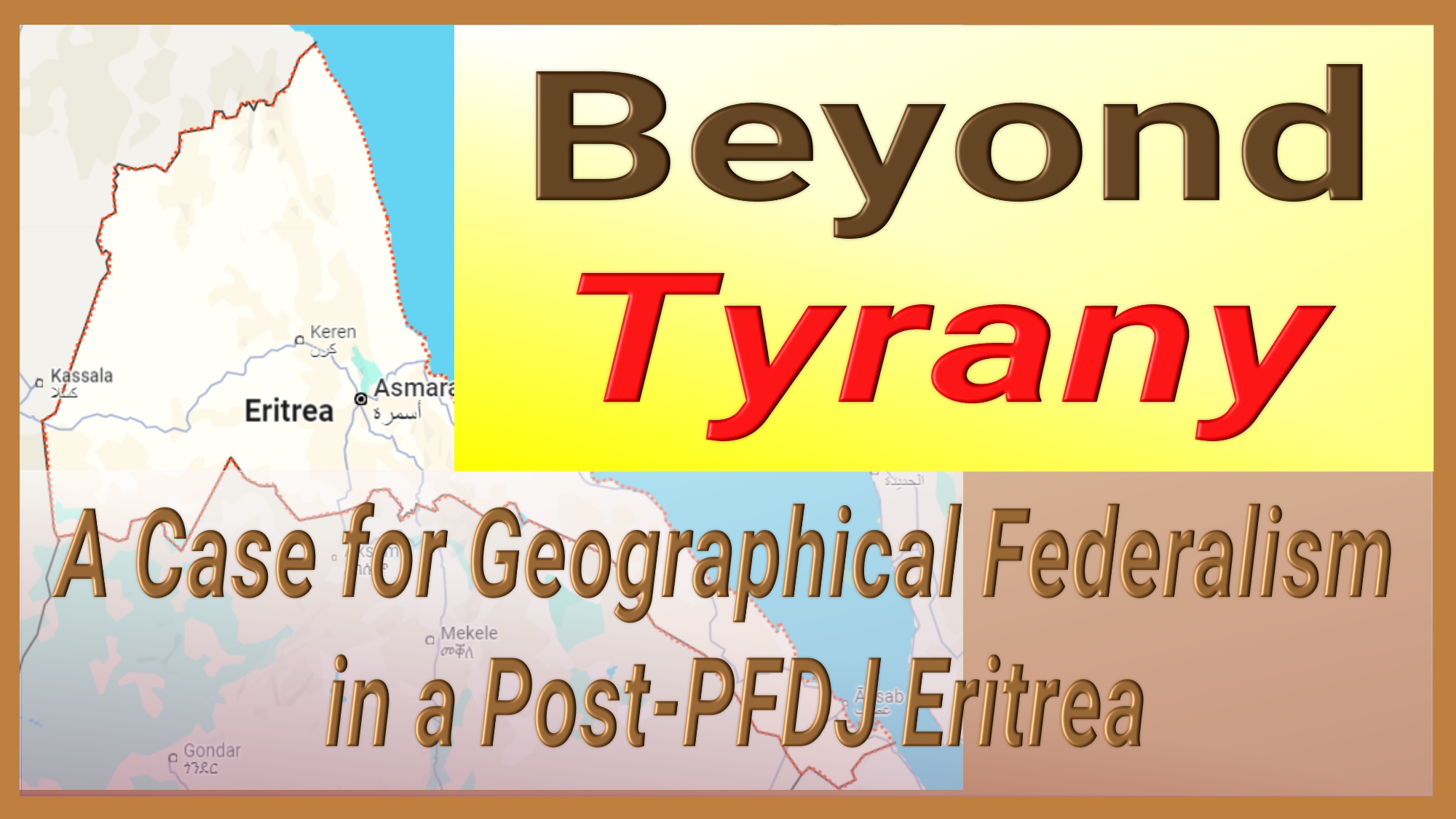
Beyond Tyranny: A Case for Geographical Federalism in a Post-PFDJ Eritrea,
by Dr. Negassi Hadgu.
Abstract
The choice of a governmental structure is a foundational decision that shapes a nation's trajectory, determining its stability, the equitable distribution of power, and the relationship between the state and its diverse populations. This article provides a comprehensive comparative analysis of three principal forms of government: the centralized unitary state model, the identity-based ethnic federal model, and the territory-based geographical federal model. It then applies this theoretical framework to the complex and unique case of Eritrea, a nation marked by profound ethno-linguistic diversity, a history of geographically defined administrative regions, and decades of a hyper-centralized, tyrannical one-man oppressive rule, propped up by the hollow People’s Front for Democracy and Justice (PFDJ). The article argues that while a unitary model risks perpetuating historical injustices and ethnic federalism carries the danger of societal fragmentation, a carefully crafted system of geographical federalism, anchored in Eritrea’s nine traditional administrative regions (Awrajas): Akele Guzay, Barka, Denkalia, Gash-Setit, Hamasien, Sahel, Semhar, Senhit, and Seraye, and reinforced with consociational power-sharing guarantees, offers the most viable and sustainable framework for building an inclusive, stable, and democratic Eritrean state in a post-PFDJ era. Furthermore, it explores the economic implications of fiscal federalism and the necessity of integrated transitional justice mechanisms to ensure sustainable development and societal reconciliation.
Part I: The Theoretical Framework, Models of Governance.
The institutional architecture of the state is neither an accidental nor a purely technocratic outcome; rather, it constitutes a deeply political settlement, shaped by the interplay between historical trajectories, socio-cultural cleavages, economic structures, and geopolitical realities. Decisions regarding the distribution of power and authority are therefore deliberate attempts to harmonize competing imperatives, including national integration, socio-political stability, territorial cohesion, and accommodation of diversity. Within the literature on comparative politics and constitutional design, two archetypal models of governance dominate scholarly discourse: the unitary system and the federal system. Each emerges from distinct philosophical assumptions about sovereignty, authority, and the management of pluralism, and each engenders its own institutional logic and political consequences.
1. The Unitary State: Centralization as a Mechanism of Political Control.
In the unitary state, sovereignty is indivisible, residing exclusively in the central authority, with any subnational administrative divisions deriving their powers from the center through devolution or delegation, rather than from constitutional guarantees. This model, employed by states such as France, Japan, and historically the United Kingdom prior to devolution reforms, emphasizes uniformity in legislative and administrative frameworks across the polity. Its primary advantages include policy coherence, streamlined governance, and the capacity to project state authority evenly across the territory.
However, the concentration of power in a central apparatus can generate political alienation in geographically peripheral or culturally distinct regions, particularly in post-colonial or post-conflict polities. Empirical studies in political sociology note that such centralized arrangements can facilitate the predominance of a single ethnolinguistic majority or political elite, marginalizing minority constituencies (Lijphart, 1999). In extreme cases, especially in states marked by personalist rule or party hegemony, the unitary system becomes a conduit for authoritarian consolidation, as documented in Jackson and Rosberg’s (1982) seminal analysis of post-independence African regimes. Once captured by dominant actors, the central government can serve as an instrument of coercion, intensifying political exclusion and precipitating secessionist pressures.
2. Federalism: The Institutionalization of Shared Sovereignty.
Federal arrangements constitute an alternative governance model predicated on the constitutional entrenchment of a vertical division of power between a central authority and territorially defined political units, states, provinces, or regions, which possess a degree of autonomy over certain domains of policymaking. Daniel J. Elazar famously characterized this system as a form of “self-rule plus shared rule” (Elazar, 1987), underscoring the dual imperative of preserving local self-determination while ensuring collective capacity for nationwide governance.
Contrary to the simplistic binary frequently drawn between unity and decentralization, comparative federalist scholarship identifies federalism as a continuum encompassing symmetrical and asymmetrical variations, as well as integrative and autonomy-seeking forms (Stepan, Linz, & Yadav, 2011). The precise design of the federation, its allocation of legislative competencies, fiscal arrangements, and constitutional safeguards, shapes its ability to manage diversity, mitigate conflict, and prevent domination by the center or the periphery.
2.1 Ethnic Federalism: Institutionalizing Identity in the State Structure.
Ethnic federalism, a specific variant of the federal principle, structures constituent units according to predominant ethnolinguistic or cultural identities. Advocates argue that such arrangements institutionalize group recognition, rectify historical marginalization, and enhance political participation among minority nations and peoples. The normative claim rests on the premise that self-determination within a federal framework can serve as a stabilizing device, countering assimilationist pressures from the center.
Nevertheless, critical scholarship, most notably Donald L. Horowitz (2000), warns of the paradox inherent in ethnically demarcated federations. By embedding ethnicity within the constitutional order, the state risks transforming political competition into a zero-sum contest premised upon identity, thereby reifying and politicizing ethnic cleavages. The Ethiopian federal experiment, codified in the 1994 Constitution, has provided a prominent empirical case in this debate. While initially heralded as a progressive mechanism for empowerment and cultural autonomy (Assefa, 2012), the system has over time contributed to periodic outbreaks of militarized ethnic conflict, jurisdictional disputes over inter-regional boundaries, and escalating secessionist movements (Ogbazghi, 2021).
Comparative political analysis suggests that by constitutionalizing ethnicity as the primary organizing principle of governance, the Ethiopian model weakened the integrative capacity of the national identity, thereby rendering the political system vulnerable to centrifugal forces (Young, 2006). This dynamic illustrates a broader governance dilemma: the very institutions designed to accommodate diversity may, under certain conditions, exacerbate the structural fragmentation of the state.
2.2 Geographical Federalism: The Interplay of Territory, History, and Power Distribution.
Geographical federalism constitutes a variant of the federal principle in which subnational units are defined not by ethno-linguistic homogeneity but by territorial, historical, political, and socio-economic criteria. These polities possess constitutionally entrenched competencies, and their internal boundaries are typically the product of negotiated political compacts, historical precedent, or deliberate statecraft rather than explicit identity-based demarcation. This institutional design is exemplified in states such as the United States, Canada, and Australia, where federations arose out of a strategic bargain: to integrate diverse territories into a unified polity while safeguarding the autonomy of constituent units, often in order to aggregate military, economic, or geopolitical capacity without eroding local governance prerogatives (Riker, 1964).
Under geographical federalism, regional governments typically exercise legislative authority over locally salient competencies such as education policy, land use regulation, infrastructure development, and natural resource management. Concurrently, the central government retains exclusive jurisdiction over domains integral to sovereignty, including national defense, foreign affairs, monetary policy, and constitutional interpretation. This vertical allocation of power is underpinned by the principle of symmetric constitutional entrenchment; that is, subnational autonomy is protected from unilateral encroachment by the center, insulating it from the volatility of political turnover.
One of the most analytically significant features of this model is its propensity to generate cross-cutting cleavages, to borrow Sartori’s (1970) terminology. By anchoring political identity partly in territorially defined units rather than exclusively in ethnic affiliation, geographical federalism creates overlapping and intersecting loyalties. Citizens can develop coexisting identifications with their regional government and the federation as a whole, a duality that tends to mitigate ethnic polarization and foster cooperation across cultural boundaries. This stands in contrast to ethnic federalism, where political mobilization often aligns squarely along identity lines, reinforcing rather than softening group divisions.
2.2.1 Comparative Applications: Stability Through Territorial Design:
The Swiss Confederation is a paradigmatic case in which geographically based federalism has been deployed to manage profound internal diversity. Switzerland comprises 26 cantons whose boundaries reflect centuries of historical evolution, local autonomy, and negotiated association, rather than ethnic exclusivity. This configuration accommodates a polity that is home to four national languages (German, French, Italian, and Romansh) and significant religious heterogeneity (including historically antagonistic Catholic and Protestant communities). The federal system entrenches extensive cantonal authority over education, taxation, law enforcement, and infrastructure, thereby grounding loyalty in local self-determination while enabling collective decision-making in matters of national relevance.
Crucially, Swiss territorial federalism is reinforced by consociational mechanisms (Lijphart, 1969; 2012). The Federal Council, Switzerland’s collective seven-member executive, is constitutionally designed to include representation from the major linguistic and political forces, ensuring that no single group monopolizes state power. This institutional combination of geographically rooted federalism with elite power-sharing has been instrumental in sustaining political stability, preventing large-scale conflict, and nurturing the co-existence of multiple national identities within a single sovereign framework.
2.2.2 Normative Implications for State Building in Heterogeneous Societies:
The comparative evidence suggests that geographical federalism, particularly when augmented by power-sharing devices at the national level, offers several governance advantages for states grappling with deep diversity. By consolidating institutions around territorially based interest representation rather than ethno-national exclusivity, it can defuse zero-sum identity competition, foster functional interdependence between regions, and promote a narrative of inclusive citizenship. However, its success is contingent on several enabling conditions: a binding constitutional framework that protects autonomy, mechanisms for intergovernmental negotiation and dispute resolution, and a political culture that valorizes compromise over majoritarian domination.
For post-conflict or deeply divided settings, such as a potential future reconfiguration of the Eritrean state, geographical federalism holds the theoretical promise of reconciling historic territorial identities, postcolonial state boundaries, and regional economic disparities without enshrining ethnic divisions in the constitutional order. When combined with carefully crafted consociational elements, it can provide a durable institutional scaffold for coexistence, gradual nation-building, and economic integration.
2.3 Comparative Synthesis: Governance Models and the Management of Diversity.
The comparative analysis of unitary systems, ethnic federalism, and geographical federalism reveals that the design of a state’s governance architecture is not merely an administrative concern but a deeply political project that shapes the distribution of power, the articulation of identity, and the potential for long-term stability. Each model embodies a distinct constitutional logic and engages differently with the central governance challenge in plural societies: reconciling political integration with the accommodation of diversity.
(a) Unitary Systems: Integration Through Centralization.
The unitary model is grounded in the principle of indivisible sovereignty, wherein authority is hierarchically organized and subnational units exist at the discretion of the central government. The primary strength of this arrangement lies in its institutional simplicity and its capacity to project uniform policy and legal standards across the state. As noted in both the French and Japanese cases, this centralization can facilitate national cohesion and coordinated economic development, particularly in relatively homogeneous polities.
However, in heterogeneous societies, the same centralization risks facilitating the monopolization of power by dominant ethnopolitical groups or by entrenched elites, as was extensively documented by Jackson and Rosberg (1982) in the context of neopatrimonial African regimes. In such environments, unitary systems are prone to engender peripheral alienation, grievance accumulation, and in extreme conditions, secessionist mobilization. Thus, while offering efficiency and cohesion, unitary systems often insufficiently address demands for political recognition and self-governance in plural contexts.
(b) Ethnic Federalism: Accommodation Through Recognition.
Ethnic federalism emerges from the philosophical premise that the formal recognition of identity categories, and granting them territorially based self-rule, can defuse historical grievances and produce stability. The Ethiopian experiment following the 1994 Constitution represents one of the most explicit instances of this approach, in which ethnic “nations” were not only granted self-administration but also constitutional rights to secession.
Empirically, such arrangements can initially expand political inclusion for previously marginalized groups and reconfigure the legitimacy of the political system, as suggested by Assefa (2012). Yet, insights from Horowitz (2000) and Young (2006) underscore a major structural risk: by hard-wiring ethnicity into the constitutional fabric, the state’s political competition becomes an ethnic zero-sum game. This can harden boundaries between groups, erode common national identity, and intensify secessionist pressures, ironically destabilizing the very polity the system seeks to preserve.
(c) Geographical Federalism: Integration Through Territorial Autonomy.
Geographical federalism constitutes a middle path where autonomy is constitutionally entrenched, but subnational units are defined on territorial, historical, or economic grounds rather than ethnic identification. Empirically exemplified by the United States, Canada, Australia, and Switzerland, this model allows for regionally tailored governance while fostering an integrated national identity through cross-cutting cleavages.
The Swiss example demonstrates how territorial federalism, supplemented by consociational governance, can sustain political stability in a society with multiple linguistic, religious, and cultural divides. In theory, this approach can protect local autonomy, prevent domination by the center, and avoid the polarizing effects of ethnic federalism, provided it is embedded in cooperative intergovernmental relations and conflict-resolution mechanisms.
2.3.1 Trade-Offs and Strategic Considerations:
A comparative evaluation along the axes of stability, inclusion, efficiency, and identity management highlights the following:
| Governance Model | Strengths | Weaknesses / Risks | Best Fit Conditions |
|---|---|---|---|
| Unitary System | Uniformity, coherence, administrative efficiency | Marginalization of minorities; central overreach; elite capture | Homogeneous societies; strong integrative national identity |
| Ethnic Federalism | Formal recognition of diversity; empowerment of marginalized groups | Institutionalization of ethnic politics; secessionist pressures | Deep historic ethnic divisions with strong self-determination claims |
| Geographical Federalism | Balances autonomy with unity; creates cross-cutting identities; mitigates ethnic tension | Requires robust constitutional safeguards, cooperative federal culture | Diverse but territorially intermixed societies; need for both unity and diversity accommodation |
2.3.2 Normative Implication for Institutional Design in Post-Conflict and Diverse States:
Geographical federalism constitutes a middle path where autonomy is constitutionally entrenched, but subnational units are defined on territorial, historical, or economic grounds rather than ethnic identification. Empirically exemplified by the United States, Canada, Australia, and Switzerland, this model allows for regionally tailored governance while fostering an integrated national identity through cross-cutting cleavages.
The Swiss example demonstrates how territorial federalism, supplemented by consociational governance, can sustain political stability in a society with multiple linguistic, religious, and cultural divides. In theory, this approach can protect local autonomy, prevent domination by the center, and avoid the polarizing effects of ethnic federalism, provided it is embedded in cooperative intergovernmental relations and conflict-resolution mechanisms.
Part II: Application, Navigating the Governance Dilemma in a Post-Authoritarian Eritrea.
The preceding theoretical discussion is not merely an abstract intellectual exercise; rather, it encapsulates choices that have profound implications for policies during systemic transformation. Eritrea constitutes a compelling case study in this regard. The country, characterized by substantial ethnic heterogeneity and burdened with the institutional scars of decades under an entrenched, predatory, and hyper-centralized regime of the PFDJ, now confronts a pivotal governance dilemma in its post-authoritarian trajectory.
3. The Eritrean Context: Historical Legacies of Centralization, Diversity, and Administrative Tradition.
Eritrean society is composed of nine ethnolinguistic communities, including the Tigrinya (approximately 50%), the Tigre (approximately 30%), and smaller groups such as the Saho (4%), Afar (4%), Kunama (2%), Bilen (2%), Nara (2%), Hedareb (1%), and Rashaida (1%) (CIA, 2021). This diversity is layered upon a longstanding geographic-administrative tradition: nine historical provinces: Akele Guzay, Barka, Denkalia, Gash-Setit, Hamasien, Sahel, Semhar, Senhit, and Seraye, whose evolution over centuries reflected organic socio-economic, cultural, and political interactions (Tronvoll, 2009). These provinces operated as primary units of governance, local identity, and collective memory until their systematic dismantling by the tyrannical one-man oppressive PFDJ regime (Killion, 1998).
The tyrannical one-man oppressive PFDJ regime’s institutional architecture exemplified what Mann (1984) characterizes as “despotic power”, where the regime’s control extended vertically into all arenas of state and society. Eritrea’s extreme unitary framework subordinated all regional administrations to the presidential office, extinguished legally recognized subnational autonomy, and suppressed public expressions of ethnic or regional affiliation under the pretext of safeguarding “national unity” (Connell, 2019). This erasure of both ethnic and provincial dimensions severely disrupted local governance traditions and deepened intergroup grievances, making institutional design not merely a technical question but one of existential significance for national cohesion.
4. Evaluating the Models for a New Eritrea.
4.1 The Delegitimization of the Unitary State.
Within Eritrea's collective political consciousness, the unitary state is inextricably linked to hyper-centralized authoritarianism, coerced homogenization, and the structural marginalization of minority populations. This historical memory undermines the legitimacy of the unitary model as a viable framework for governance in a post-tyrannical, one-man oppressive PFDJ era, given its inability to ensure meaningful protections for vulnerable groups or to distribute political power effectively across subnational levels.
4.2 The Risks of Ethnic Federalism.
Although ethnic federalism is intended to ensure group-specific representation, its application in diverse societies often leads to state fragility, entrenched identity boundaries, and divisive political forces. Eritrea’s interconnected communities make rigid ethnic boundaries impractical. Ethiopia’s volatile experience serves as a stark warning against this path (Ogbazghi, 2021). Ethnic federalism in such a context risks reinforcing identity divisions rather than fostering inclusive governance.
5. The Optimal Path: Geographical Federalism with Consociational Guarantees.
The most viable framework for Eritrea’s governance is geographical federalism based on its nine historical Awrajas, strengthened by consociational power sharing mechanisms.
A geographic federalist system, rooted in Eritrea’s centuries old provincial boundaries, offers an effective way to embrace the nation’s deep ethnic diversity while preserving established regional identities. Eritrea has nine officially recognized ethno linguistic groups, each with its own language, cultural traditions, and historic ties to specific territories. This diversity evolved over generations through distinct settlement patterns, local governance traditions, and socio economic exchanges unique to each province.
In this system, political representation would be assigned to provinces whose boundaries reflect these historical and demographic realities. Tigrinya speakers would remain the majority in Akele Guzay, Hamasien, and Seraye, while other groups would hold key roles in their regions: Kunama and Nara in Gash Setit, Tigre and Hedareb in Barka, Afar in Denkalia, Tigre and Rashaida in Sahel, Saho and Tigre in Semhar, and Bilen in Senhit. This ensures that smaller communities, often overlooked in centralized governance, maintain a meaningful voice in local decision making.
The benefits of geographic federalism are threefold. Politically, it disperses power away from any single ethnic majority, promoting fairness and inclusion. Culturally, it preserves the autonomy of each community, safeguarding languages, traditions, and institutions within a formal provincial framework. Economically, it allows provinces to design development strategies tailored to their resources and priorities, supporting balanced national growth rather than concentrating on opportunity in one central area.
Historically, Eritrea’s nine provinces served not just as administrative zones but as vibrant social, cultural, and economic centers. Restoring these divisions within a federal structure would revive traditional self governance, reinforce local accountability, and strengthen national unity through diversity. Given Eritrea’s past challenges with excessive centralization, ethnic mistrust, and uneven distribution of resources, this approach offers an inclusive and historically grounded path toward long term stability and truly representative governance.
5.1 A Structural Antidote to Tyranny.
The primary lesson from the tyrannical, one-man oppressive PFDJ era is the danger of unchecked, centralized power. geographical federalism provides a structural antidote. By constitutionally dividing sovereignty between a central government and several geographically defined regional states, the model creates multiple centers of power. This permanent decentralization makes it vastly more difficult for any single leader or party to ever again impose absolute control over the entire country (Tsebelis, 2002).
5.2 Historical Continuity and Normative Legitimacy.
Instead of fabricating new territorial demarcations, a federal schema based on Eritrea’s nine historically evolved Awrajas supports both cultural legitimacy and administrative familiarity. Leveraging these historically grounded boundaries could facilitate smoother political acceptance and reduce transitional friction, given their embeddedness in local socio-political consciousness.
5.3 Fostering a Civic National Identity.
A geographical model creates multi-ethnic regional states, forcing political parties to build cross-ethnic coalitions to govern effectively. This necessity of routine political cooperation would encourage bargaining, compromise, and the development of a shared Eritrean identity based on common civic and regional interests, rather than on ethnic exclusivity.
5.4 Balancing Autonomy with Unity.
The model addresses the legitimate demands of minority groups for self-governance over local affairs (like primary education, public infrastructure, and local economic governance) without threatening the integrity of the state. While retaining centralized control over strategic functions such as defense, currency, and foreign affairs, this dual structure balances self-governance with the preservation of state sovereignty, ensuring Eritrea remains a unified country.
5.5 A Framework for Minority Protection.
The greatest strength of this model is its flexibility. A geographical federal structure must be reinforced with strong consociational mechanisms, a set of constitutional guarantees designed to protect minority rights (Lijphart, 1979). These include:
⮚ Guaranteed Representation: A bicameral legislature with an upper house providing equal representation to each of the nine Awraja-based states, ensuring that smaller or less populous regions have an equal voice in national decision-making to prevent domination by larger groups.
⮚ Cultural and Linguistic Rights: The constitution must explicitly protect the language and cultural rights of all ethnic groups as national and individual rights, not tied to a specific ethnic territory.
⮚ Minority Veto: A mechanism in the upper house to protect the vital interests of minority communities on critical issues.
⮚ Grand Coalition Governance: A mandatory power-sharing executive at the federal level with representation from multiple regional and ethnic groups.
6. Economic Dimensions of Geographical Federalism in Eritrea.
Economic viability is critical. Eritrea’s economy is severely challenged, with a GDP per capita of approximately $600 and widespread poverty (World Bank, 2021 estimate). Decades of centralization have concentrated economic control, neglecting regions with agricultural and trade potential (Bertelsmann Stiftung, 2022). A system of fiscal federalism, which addresses the division of financial powers (Oates, 1999), can address these disparities through:
⮚ Regional Economic Autonomy and Revenue Sharing: Each state would manage local resources. A federal revenue-sharing mechanism would redistribute national revenues to less prosperous regions, reducing inequality (International Crisis Group, 2010).
⮚ Local Development Incentives: Regions could tailor projects to their unique profiles, such as cross-border trade in Gash-Setit (FAO, 2015) or tourism in Sahel (UNHCR, 2021). This contrasts with the current system where such initiatives are stifled by central control and conscription policies that drain labor (Human Rights Watch, 2021).
⮚ Risks and Mitigation: To prevent regional disparities from fueling tension, the federal government must establish a transparent fiscal framework and enforce anti-corruption measures, drawing lessons from Nigeria’s challenges (Suberu, 2009).
7. Transitional Justice as a Pillar of Federal Reconstruction.
A transition must address the tyrannical, one-man oppressive PFDJ regime's legacy of human rights abuses, which the UN found may amount to crimes against humanity (UN Commission of Inquiry, 2016). Key approaches include:
⮚ Truth and Reconciliation Commission (TRC) with Regional Representation: A national commission with branches in each Awraja to document abuses and promote reconciliation, ensuring local grievances are heard (Amnesty International, 2020). For example, hearings could address land dispossession among the Kunama in Gash-Setit (Minority Rights Group, 2019).
⮚ Reparations and Restorative Justice: A federal framework can facilitate targeted reparations managed by Awraja-based states.
⮚ Institutional Reforms and Accountability: Prosecuting high-level officials for documented crimes would signal accountability, while balancing this with amnesty for lower-level actors in exchange for truth can foster reconciliation (International Center for Transitional Justice, 2017).
Conclusion.
The task of rebuilding Eritrea from the ruins of authoritarianism requires the construction of a new social contract. This contract cannot be based on a return to a unitary state, which has proven to be an instrument of oppression, nor should it risk the nation's fragile unity on the perilous experiment of ethnic federalism. The most promising path forward is a system of geographical federalism enriched with strong consociational guarantees, built upon the foundation of Eritrea’s nine historical administrative regions (Awrajas). This model decentralizes power to prevent tyranny, fosters inter-ethnic cooperation to build a shared civic identity, and constitutionally protects all minority groups. Crafting such a system will be challenging, but it provides the most robust framework for transforming Eritrea from a land of fear into a stable, just, and inclusive nation for all its citizens.
References
- 1. Amnesty International. (2020). Eritrea: 2020 Country Report. Amnesty International.
- 2. Assefa, F. (2012). Federalism and Ethnic Conflict in Ethiopia: A Comparative Study of the Somali and Benishangul-Gumuz Regions. Leiden University Scholarly Publications.
- 3. Bertelsmann Stiftung. (2022). BTI 2022 Country Report: Eritrea. Bertelsmann Stiftung.
- 4. Central Intelligence Agency. (2021). The World Factbook: Eritrea. CIA.
- 5. Connell, D. (2019). Historical Dictionary of Eritrea (3rd ed.). Rowman & Littlefield.
- 6. Elazar, D. J. (1987). Exploring Federalism. University of Alabama Press.
- 7. Food and Agriculture Organization (FAO). (2015). Agricultural Potential in Eritrea’s Lowlands: Gash-Setit and Barka Regions. FAO Report.
- 8. Horowitz, D. L. (2000). Ethnic Groups in Conflict. University of California Press.
- 9. Human Rights Watch. (2021). Eritrea: Repression Without Borders. HRW Report.
- 10. International Center for Transitional Justice. (2017). Transitional Justice in Post-Conflict Societies: Lessons for Eritrea. ICTJ Briefing.
- 11. International Crisis Group. (2010). Eritrea: The Siege State. ICG Africa Report No. 163.
- 12. Jackson, R. H., & Rosberg, C. G. (1982). Personal Rule in Black Africa: Prince, Autocrat, Prophet, Tyrant. University of California Press.
- 13. Killion, T. (1998). Historical Dictionary of Eritrea. Scarecrow Press.
- 14. Lijphart, A. (1979). "Consociation and Federation: Conceptual and Empirical Links." Canadian Journal of Political Science, 12(3), 499-515.
- 15. Minority Rights Group. (2019). Eritrea: Minorities Under Threat – Kunama and Afar Communities. MRG Report.
- 16. Oates, W. E. (1999). "An Essay on Fiscal Federalism." Journal of Economic Literature, 37(3), 1120-1149.
- 17. Ogbazghi, P. B. (2021). "Ethiopia and the Running Sores of Ethnic Federalism: The Antithetical Forces of Statehood and Nationhood." African Studies Quarterly, 20(3).
- 18. Riker, W. H. (1964). Federalism: Origin, Operation, Significance. Little, Brown.
- 19. Suberu, R. (2009). "Federalism and Ethnic Conflict in Nigeria: Lessons for Decentralization." Journal of African Economies, 18(1), 1-35.
- 20. Tronvoll, K. (2009). The Lasting Struggle for Freedom in Eritrea: Human Rights and Political Development, 1991-2009. Sida.
- 21. Tsebelis, G. (2002). Veto Players: How Political Institutions Work. Princeton University Press.
- 22. United Nations Commission of Inquiry on Human Rights in Eritrea. (2016). Report of the Commission of Inquiry on Human Rights in Eritrea. UN Human Rights Council.
- 23. UNHCR. (2021). Eritrea: Displacement and Regional Challenges. UNHCR Briefing Notes.
- 24. World Bank. (2018, 2021 Estimate). Eritrea: Economic Indicators and Urban-Rural Disparities. World Bank Data Portal.
- 25. Young, J. (2006). "Ethiopia: Ethnic Federalism and Its Discontents." Review of African Political Economy, 33(109), 531-540.
Victory and glory to the Eritrean people!
God Bless Eritrea and its people!
A fellow Eritrean committed to freedom and justice for all,
Dr. Negassi Hadgu
Negassi9@gmail.com
October 21, 2025
Read in PDF ብ'PDF ንምንባብ ኣብዚ ጠውቑ።
A Wrong Medicine for a Wrong Diagnosis:
Beyond Geographic Federalism - Towards a Democratic, Devolved Unitary State as Eritrea's Foundation for Stability and Justice*
Dr. Gebre Gebremariam
Snitna Network Seminar: On Saturday, 19 July 2025.
Topic:
The constitutional models.
መንግስታዊ ስርዓታት
النموذج الدستوري
Panellists on Thematic Topics ተዛተይቲ:-
Decentralized model: Panelist: Judge Habteab Yemane
Federal model: Panelist: Dr Mohammed Kheir Omer
Unitary model: Panelist: Prof Kidane Mengsteab
Moderator: Dr Mebrahtu Ateweberhan
Part-1 of 4:
Part-2 of 4:
Part-3 of 4:
Part-4 of 4:
See also more articles by Dr. Negassi Hadgu
ካልኦት ብ'ዶር ነጋሲ ሓድጉ ዝተጻሕፉ ጽሑፋት ኣብ ታሕቲ ተወከሱ:-
 ብተወሳኺ፡ ነቲ ኣብ ዩቱብ ቻነል ዝወጽእ ሓበሬታ፡ ንመትከላት ማሕበራዊ መትከላት ዩቱብ (YouTube Community Guidelines)፡ እናኽበረ የውጽእ። ስኒትና፡ ብዝከኣሎ መጠን፡ ነዚ መትከላት'ዚን ናይ ሃገርና ኤርትራን ህዝባን ክዉንነትን ምርኩስ ገይሩ፡ ኣብ መርበብ ሓበሬታኡ ስኒትና (www.snitna.com) ክውጽእ ዝግብኦ ሓበሬታ እናመመየ ከውጽእ ይህቅንን ይጽዕርን። እዚ ስራሕዚ ምሉእ ዓወት ንክህልዎ ድማ ብዓቢኡ፡ ግቡእ ኣጠቓቕማ ተሳተፍቲን ምትሕብባርን ምስዝህሉ ኢዩ። ስለዚ፡ ነዚ መትከላት ዚ ንምኽባር ንኹሉ ተገልጋላይ'ዚ መርበብዚ ንጽውዕ። ዝኾነ ሃሳዪ ተርእዮታት ምስዘጋጥሙ፡ ቅሬታኹም ወይ ርእይቶኹም ብኢመይል ኣድራሻና ኣቢልኩም ክትልእኩልና ንላቦ።
 See also Related / ምስዚ ዝተኣሳሰር ሓበሬታ፡-
- Snitna YouTube - ስኒትና ዩቱብ ቻነል።
- Snitna Network and Sinit Seminars Directory. ብ`ስኒትና ከምኡ`ውን ስኒት ዝተኻየዱ ሰሚናራት።
- Snitna FaceBook - ስኒትና ፌስቡክ።
- Sinit YouTube - ስኒት ዩቱብ ቻነል።
- ዘተ ንሓባራዊ ንቕሓት
Dialogue for Common Awareness
مجموعة الحوار للوعي المشترك - ሌላ ምስ
ፖለቲካዊ ሰልፍታትን ህዝባዊ ምንቅስቓሳትን ኤርትራ፡
Eritrean Political parties and Civic movements.s
مقدمة في الأحزاب السياسية والحركات المدنية الإريترية - BUILDING DEMOCRACY IN ERITREA - ህንጸት ዲሞክራሲ ኣብ ኤርትራ بناء الديمقراطية في إريتريا
- ሕግን ሕብረተሰብን - Law and Society.
- ኣስተምህሮ፡ መስርሕ ምንዳፍ ቅዋም ኤርትራ - The Eritrean Constitution Making Process
Seminar by Dr Bereket Habte selassie. ኣስተምህሮ፡ ብ`ዶር. በረኸት ሃብተስላሰ። - ሲምፖዝዩም ኤርትራ (Eri-Platform: 2018 - 2020)
- ዋዕላ ህንጸት ዲሞክራሲ ኣብ ኤርትራ Building Democracy in Eritrea Conference (Eritrea Focus: 2019 - 2020)
- Enough is enough! ይኣክል ምልኪ! ማዕበል ድምጺ ህዝቢ لقد طفح الكيل
- 1993, Eritrean independence referendum Results
ታሪኻዊ ውጽኢት ረፈረንዱም ኤርትራ 1993. - ሃገራዊ ቻርተር ኤርትራ - ኣብ 3ይ ጉባኤ ህ.ግ.ሓ.ኤ: ዝጸደቐ (ናቕፋ 10 - 16 ለካቲት 1994)።
- PFDJ NATIONAL CHARTER Adopted by the 3rd Congress of the EPLF/PFDJ Naqfa, February 10-16, 1994.
- ንዝኽሪ ግዳያት ዲክታቶሪያዊ ምሕደራ ኤርትራ። In memory of Victims of Dictatorial Administration in Eritrea.
- G-15:- ቅልዕቲ ወረቐት ናብ ህዝቢ ኤርትራ፡ ኣገደስቲ እዋናውያን ጉዳያት፡ (ኣስመራ፡ ነሓሰ 3፡ 2001)
- G-15:-Open Letter To The People of Eritrea (Asmara, August 3, 2001)
- G-15:-ቅሉዕ መልእኽቲ ናብ ኩሎም ኣባላት ህግደፍ
- G-15:-Open Letter to All PFDJ Members (Audio) ቅሉዕ መልእኽቲ ናብ ኩሎም ኣባላት ህግደፍ (ብድምጺ)
- G-15:-Open Letter to All PFDJ Members
- GI: ህጹጽ ጻውዒት ንኹሎም ኣብ መላእ ኵርናዓት ዓለም ዝርከቡ ኤርትራውያን። An Urgent Call to All Eritreans Worldwide. المبادرة العالمية لتمكين الحركة الشعبية الاريترية
- ድምጽና (Our Voice)
- መደብ ንጋባእ ENGAGE ERITREA!
- Advice for All Eritreans ምኽሪ ንኹሎም ኤርትራውያን
- UN Human Rights Council - Human Rights in Eritrea (Website) / ናይ ውሕሃ ቤትምኽሪ ሰብኣዊ መሰላት - ኩነታት ሰብኣዊ መሰላት ኣብ ኤርትራ፡ (Website)
- UN Human Rights Council - Human Rights in Eritrea (YouTube) / ናይ ውሕሃ ቤትምኽሪ ሰብኣዊ መሰላት - ኩነታት ሰብኣዊ መሰላት ኣብ ኤርትራ፡ (YouTube)
- Human Rights in Eritrea / ኩነታት ሰብኣዊ መሰላት ኣብ ኤርትራ፡
- UN - Commission of inquiry on Eritrea / ናይ ውሕሃ መርማሪት ኮሚሽን ሰብኣዊ መሰላት ኤርትራ፡
- Mike Smith / ሚስተር ማይክ ስሚዝ፡ ኣቦ ወንበር መርማሪት ኮሚሽን ሰብኣዊ መሰላት ኤርትራ፡
- Also see: "UN - COI on Eritrea / ናይ ውሕሃ መርማሪት ኮሚሽን ሰብኣዊ መሰላት ኤርትራ፡
- UN COMMISSION OF INQUIRY ERITREA (COI-ERITREA) And POPULAR RESPONSES
- ጸብጻብ መርማሪት ኮሚሽን ሰብኣዊ መሰላት ኤርትራ፡ ህዝባዊ ግብረ-መልሲን
- ጸብጻብ መርማሪት ኮምሽን ኵነታት ሰብኣዊ መሰላት ኣብ ኤርትራ – ዘይወግዓዊ ትርጉም (ብትግርኛ)