

09/03/2026 23:46 PM
DINNER FOR BULLETS:
How authoritarian regimes in Eritrea, Sudan, and Ethiopia are turning their citizens into proxies and pawns
by Dr. Negassi Hadgu
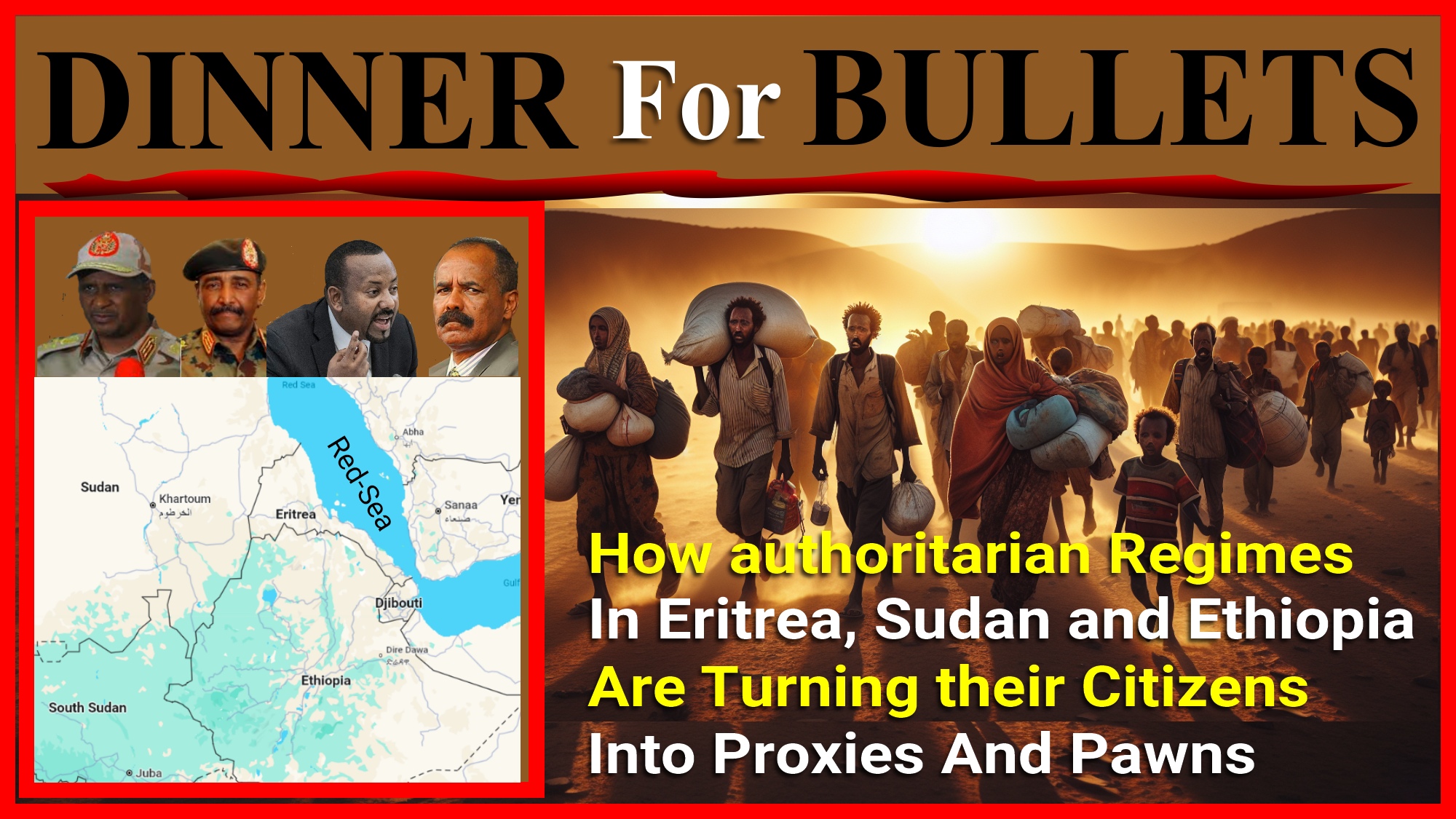
DINNER FOR BULLETS: How authoritarian regimes in Eritrea, Sudan, and Ethiopia are turning their citizens into proxies and pawns.
By Dr. Negassi Hadgu.
February 26, 2026
ABSTRACT
In the Horn of Africa, the social contract has not merely eroded; it has been deliberately inverted. Across Ethiopia, Eritrea, and Sudan, authoritarian regimes have perfected a system of governance where citizen welfare is liquidated to purchase regime survival. This manuscript analyzes the "Dinner for Bullets" phenomenon a transactional political economy where food security, sovereign territory, and human capital are traded for foreign military patronage. Anchored by the February 2026 revelations of UAE-financed mercenary training camps in Ethiopia, this analysis explores how the region has become a theater for Middle Eastern security competition. It argues that the current crisis is not a result of state failure, but of state success in repurposing populations as expendable assets in a transnational war marketplace defined by drone warfare, mercenary labor, and the deliberate weaponization of hunger. The paper proceeds in four parts: first, examining the Tigray conflict (2020–2022) as a proof-of-concept for this model; second, tracing its franchise expansion into Sudan (2023–2026); third, analyzing the 2026 Ethiopia-Eritrea reversal as evidence of the model's inherent instability; and fourth, documenting the human cost extracted from a generation denied both bread and education.
INTRODUCTION: THE BENISHANGUL BLUEPRINT
In early February 2026, satellite imagery and investigative reporting confirmed a disturbing geopolitical development in the Horn of Africa. Deep within Ethiopia's Benishangul-Gumuz region, a zone historically marginalized and fraught with ethnic tension, a secret military facility had gone operational. The camp, outfitted with advanced drone ground-control stations and reported barracks capacity for up to 10,000 troops, was not constructed to defend Ethiopian territory. According to a Reuters exclusive, it was financed by the United Arab Emirates to train recruits for the Rapid Support Forces (RSF), the paramilitary faction engaged in a devastating civil war in neighboring Sudan (Reuters, 2026a).
The recruits filling these barracks are not ideologues. They are the economic casualties of Ethiopia's soaring inflation, young men lured by the promise of salaries denominated in hard currency while their families face acute food insecurity at home. They are, in the most literal sense, trading their lives to feed their kin.
This facility represents the convergence of several regional pathologies into a single, grim model. It is the physical manifestation of what this paper terms "Dinner for Bullets": a system in which the biological survival needs of citizens are sacrificed to sustain the war machines of governing elites. In this emerging political marketplace, sovereignty is subcontracted to the highest foreign bidder, starvation functions as a logistical instrument of control, and citizens are reduced to two roles: collateral damage in domestic purges, or exportable labor for foreign proxy conflicts.
This is not state failure. This is state strategy.
I. THE TIGRAY LABORATORY (2020–2022): TESTING THE MODEL
The war in Tigray (November 2020 – November 2022) served as the proof-of-concept for transnational authoritarian outsourcing. While the conflict originated as a constitutional confrontation between Prime Minister Abiy Ahmed's Prosperity Party and the Tigray People's Liberation Front (TPLF), it rapidly evolved into a testing ground for foreign military technology and regional proxy coordination.
A. The Technocratic Slaughter
The survival of the Ethiopian federal government was purchased through a rapid, debt-accelerated acquisition of foreign military technology. By drawing down foreign currency reserves, funds otherwise essential for importing medicine, fertilizer, and fuel, Addis Ababa assembled a multi-sourced arsenal of unmanned aerial vehicles (UAVs) that became the decisive instrument of the war:
1. The Bayraktar TB2 (Turkey) Provided tactical precision strike capability, decimating TPLF armored columns in open terrain and marking Ethiopia as among the first African states to deploy combat drones at scale (Bellingcat, 2021).
2. The Wing Loong II (China) Offered heavier payload capacity for sustained strike operations, while Beijing simultaneously provided diplomatic cover at the UN Security Council, blocking Western-sponsored resolutions condemning the conflict (Bellingcat, 2021).
3. The Mohajer-6 (Iran) Procured opportunistically, this acquisition signaled Addis Ababa's willingness to engage sanctioned states, reflecting the regime's prioritization of military survival over international reputational costs (Bellingcat, 2021).
4. The UAE Logistical Network Served as the operational backbone of the entire enterprise. Bellingcat's open-source investigators documented a sustained air bridge of military cargo flights into Addis Ababa Bole International Airport, while the UAE simultaneously provided billions of dollars in currency swap agreements to stabilize the Ethiopian birr enabling the regime to sustain arms purchases while millions of its citizens faced famine conditions (Bellingcat, 2021; de Waal, 2021).
The fiscal cost of this arsenal was not borne by the regime alone. It was extracted from the population through import compression, currency depreciation, and the systematic underfunding of humanitarian response. The weapons were bought with the food budget.
B. Eritrea's Conscript Export
Simultaneously, Eritrean President Isaias Afwerki provided the human capital the drone war could not supply ground forces willing or more precisely, compelled to absorb casualties at scale. The deployment of Eritrean Defense Forces (EDF) into Tigray was not a conventional military alliance. It was the operational export of a totalitarian labor system.
Eritrea's indefinite national service program condemned by the UN Special Rapporteur as constituting forced labor and, in documented cases, conditions analogous to slavery enabled Afwerki to deploy tens of thousands of conscripts as expendable infantry (UN Human Rights Council, 2020). These forces were documented by Amnesty International and Human Rights Watch as responsible for systematic atrocities, including the Axum massacre, as well as the deliberate destruction of Tigray's agrarian infrastructure: smashing irrigation systems, poisoning wells, and slaughtering livestock (Amnesty International, 2021; Human Rights Watch, 2022).
This destruction was not incidental. As Alex de Waal (2021) has documented in his analysis of conflict-induced famine, the targeting of food systems in wartime follows a recognizable logic of coercive control: eliminate the population's capacity for self-sustenance, and you eliminate the material basis for resistance. The "dinner" of the Tigrayan population was not destroyed as a byproduct of war. It was destroyed as a condition of pacification.
II. THE FRANCHISE EXPANSION: SUDAN (2023–Present)
If Tigray was the laboratory, Sudan is the mass-market application. The armed conflict between the Sudanese Armed Forces (SAF) and the Rapid Support Forces (RSF), which erupted in April 2023, has displaced over 10 million people and produced what the United Nations has described as the world's largest acute displacement crisis (Reuters, 2026a). To frame this as a civil war, however, is a category error. It is more accurately understood as a resource war financed by external actors whose strategic interests in Sudan's geography and mineral wealth long predate the current conflict.
A. The Gold-for-Guns Loop
The UAE's involvement in Sudan is consistent with its strategic engagement model in Yemen and Libya, but executed with greater depth and longer-term institutional investment. By backing General Mohamed Hamdan Dagalo, known as Hemedti and the RSF, Abu Dhabi seeks to install a client regime with control over Sudan's Red Sea coastline, vast agricultural land, and significant mineral resources. The financial architecture of this relationship operates as a closed, self-reinforcing loop:
1. Extraction RSF forces secure artisanal and semi-industrial gold mining operations across Darfur and Kordofan, establishing physical control over Sudan's primary source of hard currency earnings.
2. Monetization Gold is transported to Dubai, where it enters international commodity markets through UAE-based trading companies operating with minimal beneficial ownership transparency, effectively functioning as conflict revenue laundering mechanisms (de Waal, 2021).
3. Reinvestment Proceeds are converted into weapons consignments, logistics financing, and political patronage, channeled back to the RSF through supply corridors running through Chad and as confirmed by the February 2026 revelations, through Ethiopian territory.
The Ethiopian training facility represents a critical escalation of this loop. Prime Minister Abiy Ahmed, confronting a severe foreign exchange liquidity crisis and a deteriorating domestic security environment, appears to have entered a transactional arrangement in which Ethiopian territory is leased as a logistics and training platform in exchange for Gulf financial support. This "subcontracting of sovereignty" trading territorial integrity for fiscal relief transforms the Ethiopian state from a regional actor into a service provider for Gulf security architecture, while Ethiopian citizens are conscripted into a war that poses no strategic threat to Ethiopia and offers them no national benefit.
B. The Mercenary Recruitment Economy
The mechanism of recruitment in Ethiopia illuminates the "Dinner for Bullets" logic with particular clarity. According to Reuters (2026a), recruiters operating in economically depressed regions including areas affected by post-conflict unemployment following the Tigray war offered monthly salaries of $200–$500 USD, denominated in hard currency, to men with no formal military training. In a context where the Ethiopian birr has lost over 60% of its value against the US dollar since 2020, and where food prices have tripled in major urban markets (IMF, 2025), these sums represent a genuine survival calculation, not a political choice.
The recruiter is inflation. The enlistment office is an empty grain store.
III. THE 2026 REVERSAL: WHEN THE MODEL TURNS ON ITSELF
The transactional nature of the alliances described above contains the seeds of their own instability. Arrangements built on mutual convenience rather than shared strategic interest fracture the moment the convenience calculus shifts. By early 2026, the Ethiopia-Eritrea axis forged in the collective violence of Tigray had collapsed, exposing the structural fragility at the heart of the region's security architecture.
A. The Port Ambition and the Security Dilemma
The proximate trigger for the breakdown was Prime Minister Abiy Ahmed's increasingly explicit assertion that landlocked Ethiopia required sovereign sea access. His government's stated ambition to secure either a leased or sovereign port on the Red Sea coast, expressed through repeated declarations that Ethiopia "cannot remain a prisoner of geography", identified the Eritrean port of Assab as the most geographically logical candidate (Plaut, 2021; Reuters, 2026b).
For tyrant Isaias Afwerki, this was not an abstract diplomatic concern. It constituted an existential territorial threat. An implicit or explicit claim on Assab transforms Ethiopia, overnight, from a strategic partner into a territorial predator. The response followed the logic of the classic security dilemma: facing a credible threat from a formerly allied state, Eritrea was compelled to rebuild deterrence capacity through whatever means were immediately available (Posen, 1993).
The means available were Ethiopia's internal enemies.
B. The Alliance Inversion
In a strategic reversal that would have been unimaginable in 2021, Eritrea began providing material support to armed factions operating inside Ethiopia including Fano Amhara militias and organizational remnants of the TPLF, the very forces Eritrean troops had fought to annihilate just three years prior (Reuters, 2026b). The interception of Eritrean ammunition convoys by Ethiopian federal security forces in February 2026 provided documentary confirmation that Asmara was actively working to destabilize its former partner (Reuters, 2026b).
This inversion is not ideologically incoherent. It is transactionally rational. Eritrea does not arm Fano militias because it supports Amhara nationalism. It arms them because a destabilized Ethiopia cannot project military force toward Assab. In the Dinner for Bullets political economy, yesterday's enemy is today's useful proxy, and alliances are instruments, not commitments.
C. Totalitarian Gaslighting and the Domestic Function of Information Warfare
The public response from both Addis Ababa and Asmara has been a coordinated retreat into mutual accusation. Governments that jointly orchestrated the siege and deliberate starvation of Tigray between 2020 and 2022 now compete to invoke the language of international humanitarian law against one another. Each accuses the other of aggression, civilian targeting, and regional destabilization.
This is not hypocrisy in the conventional sense. It is a deliberate information warfare strategy serving a critical domestic function: by maintaining populations in a state of continuous, disorienting threat perception, both regimes prevent the emergence of the civic space required for organized political opposition. When citizens are mobilized in fear, they cannot mobilize in solidarity. The gaslighting of the international community is incidental; the gaslighting of the domestic population is the point.
IV. THE HUMAN LEDGER: A GENERATION ERASED
The geopolitical transactions documented in the preceding sections are not abstract policy maneuvers. Each transaction extracts a direct and quantifiable biological and cognitive tax from living populations. This section documents three compounding dimensions of that cost.
A. The Weaponization of Inflation
The decision by Ethiopian and Sudanese authorities to allocate scarce foreign exchange to arms procurement rather than food and medicine imports has produced severe and predictable macroeconomic consequences. Ethiopia's year-on-year food inflation exceeded 30% in 2024, while the birr's sustained depreciation has compressed real household purchasing power to levels not recorded since the late 1990s (IMF, 2025). In Sudan, conflict-driven market fragmentation has produced localized hyperinflationary conditions in RSF-controlled territories, where basic food staples are priced beyond the reach of the majority of displaced households (FAO, 2025).
The political economy of this inflation is not incidental to the conflict. It is structurally integral to it. When the civilian labor market cannot offer survival wages, the armed faction which pays in hard currency and guarantees food security for the recruit's household becomes the rational employer of last resort. Inflation is not merely a consequence of the war economy. It is a recruitment subsidy for militia forces. The empty grain store is the most effective enlistment officer in the Horn of Africa.
B. The Destruction of the Agrarian Base
In Tigray and the adjoining Amhara and Afar borderlands, the deliberate targeting of agricultural infrastructure during 2020–2022 and the renewed military mobilization across the region in 2026, has produced a compounding agricultural crisis with multi-year consequences. Farmers displaced by conflict lose not one harvest but the accumulated productive capital of years: draft animals, seed stock, irrigation access, and market relationships that take generations to establish and months to destroy.
The forex compression produced by arms procurement has simultaneously reduced Ethiopia's capacity to import commercial fertilizer, creating a structural agricultural input shortage that the Food and Agriculture Organization projects will suppress yields significantly through at least the 2026–2027 growing season (FAO, 2025). Wars fought today are engineering famines for tomorrow. The harvest failure is not a risk; it is a scheduled consequence of decisions already made.
C. The Education Void and the Foreclosure of the Future
In Eritrea, the permanent war-footing governance model has effectively abolished the institutional distinction between education and military conscription. Secondary school functions in practice as a staging ground for compulsory national service, with the final year of the curriculum completed under military command at the Sawa Defense Training Center (UN Human Rights Council, 2020). University enrollment as a percentage of the relevant age cohort ranks among the lowest in sub-Saharan Africa, a direct consequence of a governance model that treats human capital formation as a threat to military manpower supply (UN Human Rights Council, 2020).
The consequence extends far beyond individual deprivation. It represents the systematic dismantling of the human capital foundation required for economic diversification and long-term development. A society whose young people are trained to fight rather than to build, design, analyze, or innovate remains permanently dependent on the one resource the state has in structural abundance: military labor available for external rent. The education void does not merely impoverish a generation. It locks the country into the war economy by ensuring that no credible alternative economy can emerge to compete with it.
CONCLUSION: DE-FINANCING THE WAR MARKETPLACE
The crisis documented in this paper cannot be resolved through conventional diplomatic mediation, because the parties to these conflicts are not, in any meaningful sense, incentivized to seek peace. Peace is denominated in local currency and political risk. War is denominated in dollars, dirhams, and drone contracts. Until that fundamental calculus is altered from outside, the belligerents will continue to optimize for conflict as a revenue stream.
The "Dinner for Bullets" cycle is sustained by an external financial architecture that renders war more profitable than governance. Dismantling that cycle requires attacking that architecture directly, through three complementary and mutually reinforcing instruments.
1. Targeted Financial Decoupling
Western governments and multilateral financial institutions must move beyond generic sanctions rhetoric to identify and disrupt the specific financial vehicles through which conflict revenues are laundered and recycled into further violence. This includes gold trading networks operating through UAE free trade zones, currency swap arrangements that provide fiscal cover for arms-buying regimes, and the correspondent banking relationships that connect these networks to dollar-denominated international finance. The UAE's role as the primary financial intermediary of the Horn's war economy is not a secret; it is a documented pattern that Western partners have thus far chosen to tolerate in deference to Gulf diplomatic and energy relationships. That tolerance has a body count. It must end.
2. Dual-Use Technology Controls
The UN Security Council's existing arms embargo mechanisms have proven structurally inadequate to the challenge of commercial drone proliferation. The Bayraktar TB2, the Wing Loong II, and their successors are not manufactured as weapons systems in the traditional procurement sense; they are marketed as dual-use platforms and converted to lethal combat use after delivery, often with the full knowledge of the supplying state. Closing this loophole requires new multilateral export control frameworks that treat drone ground-control infrastructure, targeting software, satellite uplink systems, and weapons integration components as munitions-equivalent technologies subject to mandatory end-use monitoring and revocable export licenses. States that supply these technologies to conflict zones must bear legal accountability for their battlefield application.
3. Conditionality of Concessional Finance
The International Monetary Fund, World Bank, and bilateral creditors currently providing debt relief and balance-of-payments support to Ethiopia and Sudan must introduce verifiable military spending conditionality into their program frameworks. Regimes that are simultaneously receiving concessional financing and spending scarce foreign exchange on imported weapons systems are, in effect, receiving subsidized armament from the international community. This is not a sustainable or defensible policy position. Conditionality frameworks must require transparent military budget disclosure, independent auditing of arms procurement expenditures, and binding commitments to redirect a defined percentage of forex savings from arms reduction toward food security and agricultural inputs. Regimes must be forced to choose, in concrete fiscal terms, between solvency and armament.
A Final Word
From the trenches of Sawa to the ports of Sudan, from the gold mines of Darfur to the barracks of Awash Arba, the story is the same. The conscript, the teenager, and the recruit did not choose this war. They chose to eat. They chose to ensure that their mothers, their children, and their siblings could survive another day.
The system that forced that brutal choice upon them, fight as proxies or watch your family starve was not an accident. It was engineered. It is sustained by Saudi Arabia and the Gulf states channeling petrodollars into militias; by Egypt safeguarding its Nile interests through shadow alliances; by Iran and Turkey flooding the market with opportunistic arms; and by Israel trading drone technology for influence. These powers treat the Horn of Africa as a disposable chessboard.
This network has collectively decided that the lives of East Africans are fair currency for their geopolitical ambitions.
They are wrong.
This is not underdevelopment. This is not ancient ethnic hatred. This is not the inevitable consequence of geography.
This is the “Dinner for Bullets.” And someone built the table.
REFERENCES
- 1. mnesty International. (2021). Ethiopia: Eritrean troops massacre hundreds of Axum civilians. Amnesty International Publications. https://www.amnesty.org/en/documents/afr25/3730/2021/en/
- 2. Bellingcat Investigative Team. (2021). Valley of the drones: Investigating the UAE air bridge to Ethiopia. Bellingcat. https://www.bellingcat.com
- 3. de Waal, A. (2021). Starvation as a weapon of war: Sudan, Ethiopia, and the political economy of famine. World Peace Foundation. https://worldpeacefoundation.org
- 4. Food and Agriculture Organization of the United Nations. (2025). Horn of Africa food security outlook: 2025–2027. FAO. https://www.fao.org
- 5. Human Rights Watch. (2022). "We will erase you from this land": Crimes against humanity and ethnic cleansing in Ethiopia's western Tigray zone. HRW Publications. https://www.hrw.org
- 6. International Monetary Fund. (2025). Ethiopia: Article IV consultation and staff report. IMF Country Report. https://www.imf.org
- 7. Plaut, M. (2021). Understanding Eritrea: Inside Africa's most repressive state (Updated ed.). Hurst Publishers.
- 8. Posen, B. R. (1993). The security dilemma and ethnic conflict. Survival, 35(1), 27–47. https://doi.org/10.1080/00396339308442672
- 9. Reuters. (2026a, February 10). Exclusive: Ethiopia hosts UAE-funded training camps for Sudan's RSF. Reuters. https://www.reuters.com
- 10. Reuters. (2026b, February 8). Ethiopia and Eritrea trade accusations as border troops mobilize. Reuters. https://www.reuters.com
- 11. United Nations Human Rights Council. (2020). Detailed findings of the Commission of Inquiry on Human Rights in Eritrea. UN Doc. A/HRC/44/CRP.2. https://www.ohchr.org
Read in PDF ብ'PDF ንምንባብ ኣብዚ ጠውቑ።
See also more articles by Dr. Negassi Hadgu
ካልኦት ብ'ዶር ነጋሲ ሓድጉ ዝተጻሕፉ ጽሑፋት ኣብ ታሕቲ ተወከሱ:-
 ብተወሳኺ፡ ነቲ ኣብ ዩቱብ ቻነል ዝወጽእ ሓበሬታ፡ ንመትከላት ማሕበራዊ መትከላት ዩቱብ (YouTube Community Guidelines)፡ እናኽበረ የውጽእ። ስኒትና፡ ብዝከኣሎ መጠን፡ ነዚ መትከላት'ዚን ናይ ሃገርና ኤርትራን ህዝባን ክዉንነትን ምርኩስ ገይሩ፡ ኣብ መርበብ ሓበሬታኡ ስኒትና (www.snitna.com) ክውጽእ ዝግብኦ ሓበሬታ እናመመየ ከውጽእ ይህቅንን ይጽዕርን። እዚ ስራሕዚ ምሉእ ዓወት ንክህልዎ ድማ ብዓቢኡ፡ ግቡእ ኣጠቓቕማ ተሳተፍቲን ምትሕብባርን ምስዝህሉ ኢዩ። ስለዚ፡ ነዚ መትከላት ዚ ንምኽባር ንኹሉ ተገልጋላይ'ዚ መርበብዚ ንጽውዕ። ዝኾነ ሃሳዪ ተርእዮታት ምስዘጋጥሙ፡ ቅሬታኹም ወይ ርእይቶኹም ብኢመይል ኣድራሻና ኣቢልኩም ክትልእኩልና ንላቦ።
 See also Related / ምስዚ ዝተኣሳሰር ሓበሬታ፡-
- Snitna YouTube - ስኒትና ዩቱብ ቻነል።
- Snitna Network and Sinit Seminars Directory. ብ`ስኒትና ከምኡ`ውን ስኒት ዝተኻየዱ ሰሚናራት።
- Snitna FaceBook - ስኒትና ፌስቡክ።
- Sinit YouTube - ስኒት ዩቱብ ቻነል።
- ዘተ ንሓባራዊ ንቕሓት
Dialogue for Common Awareness
مجموعة الحوار للوعي المشترك - ሌላ ምስ
ፖለቲካዊ ሰልፍታትን ህዝባዊ ምንቅስቓሳትን ኤርትራ፡
Eritrean Political parties and Civic movements.s
مقدمة في الأحزاب السياسية والحركات المدنية الإريترية - BUILDING DEMOCRACY IN ERITREA - ህንጸት ዲሞክራሲ ኣብ ኤርትራ بناء الديمقراطية في إريتريا
- ሕግን ሕብረተሰብን - Law and Society.
- ኣስተምህሮ፡ መስርሕ ምንዳፍ ቅዋም ኤርትራ - The Eritrean Constitution Making Process
Seminar by Dr Bereket Habte selassie. ኣስተምህሮ፡ ብ`ዶር. በረኸት ሃብተስላሰ። - ሲምፖዝዩም ኤርትራ (Eri-Platform: 2018 - 2020)
- ዋዕላ ህንጸት ዲሞክራሲ ኣብ ኤርትራ Building Democracy in Eritrea Conference (Eritrea Focus: 2019 - 2020)
- Enough is enough! ይኣክል ምልኪ! ማዕበል ድምጺ ህዝቢ لقد طفح الكيل
- 1993, Eritrean independence referendum Results
ታሪኻዊ ውጽኢት ረፈረንዱም ኤርትራ 1993. - ሃገራዊ ቻርተር ኤርትራ - ኣብ 3ይ ጉባኤ ህ.ግ.ሓ.ኤ: ዝጸደቐ (ናቕፋ 10 - 16 ለካቲት 1994)።
- PFDJ NATIONAL CHARTER Adopted by the 3rd Congress of the EPLF/PFDJ Naqfa, February 10-16, 1994.
- ንዝኽሪ ግዳያት ዲክታቶሪያዊ ምሕደራ ኤርትራ። In memory of Victims of Dictatorial Administration in Eritrea.
- G-15:- ቅልዕቲ ወረቐት ናብ ህዝቢ ኤርትራ፡ ኣገደስቲ እዋናውያን ጉዳያት፡ (ኣስመራ፡ ነሓሰ 3፡ 2001)
- G-15:-Open Letter To The People of Eritrea (Asmara, August 3, 2001)
- G-15:-ቅሉዕ መልእኽቲ ናብ ኩሎም ኣባላት ህግደፍ
- G-15:-Open Letter to All PFDJ Members (Audio) ቅሉዕ መልእኽቲ ናብ ኩሎም ኣባላት ህግደፍ (ብድምጺ)
- G-15:-Open Letter to All PFDJ Members
- GI: ህጹጽ ጻውዒት ንኹሎም ኣብ መላእ ኵርናዓት ዓለም ዝርከቡ ኤርትራውያን። An Urgent Call to All Eritreans Worldwide. المبادرة العالمية لتمكين الحركة الشعبية الاريترية
- ድምጽና (Our Voice)
- መደብ ንጋባእ ENGAGE ERITREA!
- Advice for All Eritreans ምኽሪ ንኹሎም ኤርትራውያን
- UN Human Rights Council - Human Rights in Eritrea (Website) / ናይ ውሕሃ ቤትምኽሪ ሰብኣዊ መሰላት - ኩነታት ሰብኣዊ መሰላት ኣብ ኤርትራ፡ (Website)
- UN Human Rights Council - Human Rights in Eritrea (YouTube) / ናይ ውሕሃ ቤትምኽሪ ሰብኣዊ መሰላት - ኩነታት ሰብኣዊ መሰላት ኣብ ኤርትራ፡ (YouTube)
- Human Rights in Eritrea / ኩነታት ሰብኣዊ መሰላት ኣብ ኤርትራ፡
- UN - Commission of inquiry on Eritrea / ናይ ውሕሃ መርማሪት ኮሚሽን ሰብኣዊ መሰላት ኤርትራ፡
- Mike Smith / ሚስተር ማይክ ስሚዝ፡ ኣቦ ወንበር መርማሪት ኮሚሽን ሰብኣዊ መሰላት ኤርትራ፡
- Also see: "UN - COI on Eritrea / ናይ ውሕሃ መርማሪት ኮሚሽን ሰብኣዊ መሰላት ኤርትራ፡
- UN COMMISSION OF INQUIRY ERITREA (COI-ERITREA) And POPULAR RESPONSES
- ጸብጻብ መርማሪት ኮሚሽን ሰብኣዊ መሰላት ኤርትራ፡ ህዝባዊ ግብረ-መልሲን
- ጸብጻብ መርማሪት ኮምሽን ኵነታት ሰብኣዊ መሰላት ኣብ ኤርትራ – ዘይወግዓዊ ትርጉም (ብትግርኛ)