

11/05/2026 23:25 PM
Sovereignty Is Inviolable:
Dismantling the Revisionist Logic of Ethiopia’s 'Maritime Imperative'
by Dr. Gebre Gebremariam
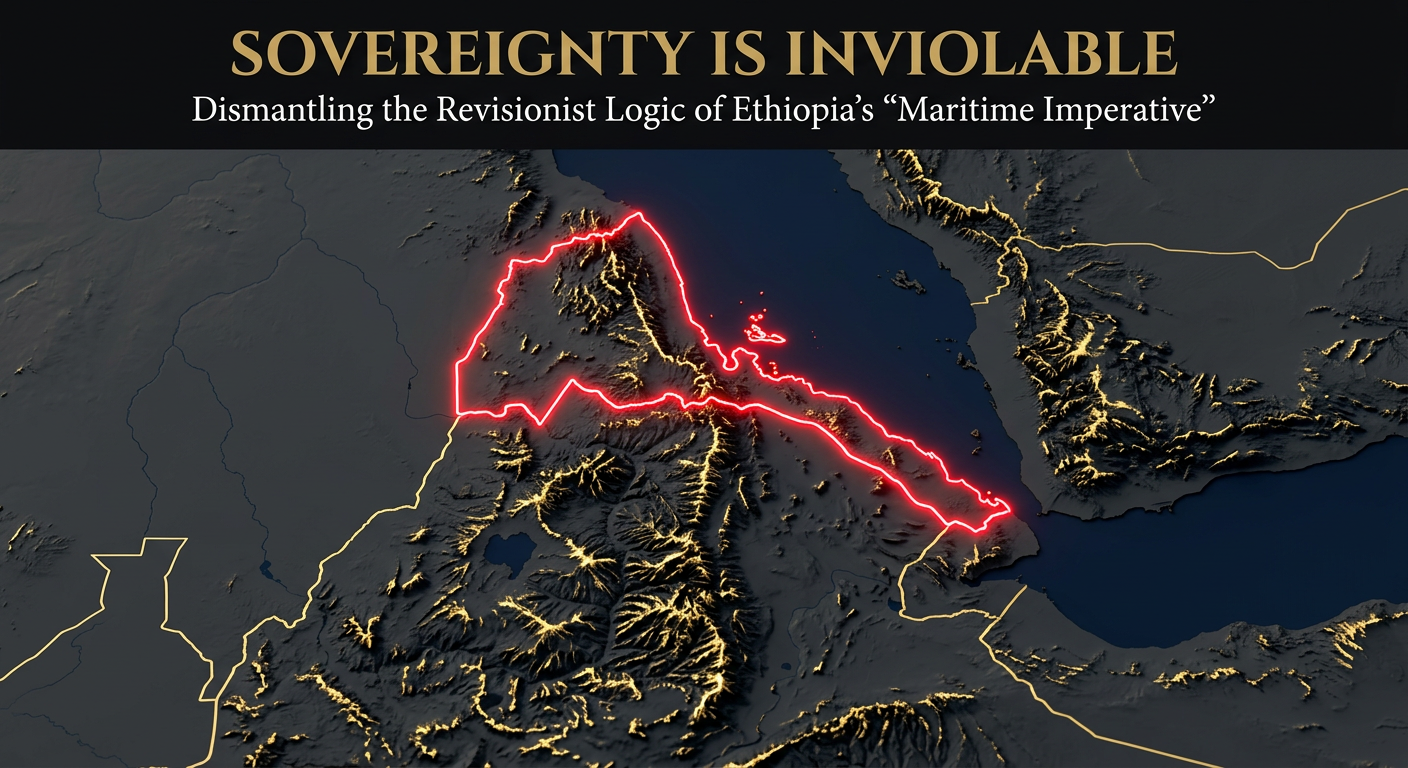
Sovereignty Is Inviolable: Dismantling the Revisionist Logic of Ethiopia’s 'Maritime Imperative'
Dr. Gebre Gebremariam
Context: The recent discourse surrounding Ethiopia’s purported 'Maritime Imperative,' epitomized by Tsega’ab Amare’s article in the Horn Review, represents
a sophisticated but legally hollow attempt to dress historical revisionism and territorial ambition in the garb of modern 'realpolitik.' By invoking a global shift from liberal institutionalism to 'power-based' realism, Amare seeks to normalize Ethiopia's belligerent stance toward Eritrean sovereignty as an inevitable byproduct of geopolitical evolution (Amare 2026). However, through my extensive analysis of international law, regional history, and the internal dynamics of the Ethiopian state, I have consistently exposed this 'imperative' to be – not a strategic necessity – but a pretext for aggression designed to mask domestic failures.
The Sovereignty Fallacy, and the Misuse of Realism
The central thesis of the Horn Review article rests on the pernicious doctrine that international law and sovereignty are now 'negotiable' in an age of realism. Amare cites the annexation of Crimea and the South China Sea disputes as evidence that “sovereignty ceases to serve as an absolute guarantee” (Amare 2026). This is a profound misinterpretation of the international system. As I argue in Sovereignty Under Siege, the violation of international norms by some states does not render those norms obsolete; rather, it identifies the violators as pariahs (Gebremariam 2026a).
To suggest that Ethiopia’s status as a landlocked nation grants it a right to sovereign Eritrean territory – namely the port of Assab – is to advocate for an anarchic regional order. While Ethiopia frequently cites the United Nations Convention on the Law of the Sea (UNCLOS), it conveniently ignores the text of Article 125. While Article 125(1) grants landlocked states the right of access, Article 125(3) explicitly stipulates that transit states “shall enjoy full sovereignty over their territory” and have the right to take all measures necessary to ensure that such rights “shall in no way infringe their legitimate interests” (UNCLOS 1982). In my work, The Genealogy of Aggression, I deconstruct how Addis Ababa attempts to bypass these legal frameworks by framing its demands as a 'structural necessity' (Gebremariam 2025a). In reality, no amount of demographic weight grants a state the right to annex or forcibly “share” the sovereign assets of a neighbor.
Beyond maritime law, Ethiopia’s neo-expansionist discourse constitutes a direct assault on the foundational pillars of the United Nations Charter. Amare’s assertion that 'power precedes principle' is a rejection of Article 2(4), which strictly prohibits not only the use of force but the threat of force against the territorial integrity or political independence of any state. By suggesting that outcomes will be 'imposed' if negotiations fail, the Ethiopian narrative adopts a posture of illegal belligerence. Furthermore, Article 2(7) explicitly protects the domestic jurisdiction of states from external interference, affirming that the sovereign management of Eritrean ports is an internal matter beyond the reach of Ethiopian 'maritime statecraft.' As I emphasize in Sovereignty Under Siege, these are not optional 'liberal expectations' - they are the mandatory legal prerequisites for global peace and security (Gebremariam 2026a).”
The “Bashashafication” of Truth: Domestic Diversion as Foreign Policy
The narrative of “maritime statecraft” is inseparable from the domestic crises currently fracturing the Ethiopian state. The Prime Minister’s focus on the Red Sea is a classic example of what I term 'The Bashashafication of Truth' – a revisionist strategy used to scapegoat external actors for internal instability (Gebremariam 2026b). By manufacturing a 'maritime dilemma,' the Ethiopian administration seeks to create a nationalistic rallying cry to distract from the intractable conflicts in the Amhara, Oromia, and Tigray regions.
Amare frames Red Sea access as a 'core national security issue' for 130 million people (Amare 2026). However, I have identified this as a Prosperity Façade (Gebremariam 2025h). Ethiopia’s economic woes are not the result of being landlocked. As I demonstrate in The Red Sea Mirage, Ethiopia enjoyed significant economic growth between 1998 and 2018 without utilizing Eritrean ports, proving that landlockedness is not a 'geographical prison' but a matter of internal governance and policy (Gebremariam 2025e). Nations like Switzerland and Rwanda thrive without coastlines; Ethiopia’s Geopolitical Quagmire is the product of systemic corruption and its own belligerent regional policies (Gebremariam 2025f, Gebremariam 2025i).
Assab: The Cradle of Eritrea, Not a Shared Commodity
The Horn Review asserts that Ethiopia’s interest in Assab is an example of “diversification and cooperative access” (Amare 2026). This is a euphemism for territorial revisionism. As I highlight in Assab: The Cradle of Eritrea, this site is a point of profound national significance that was never 'lost' by Ethiopia because it never legally belonged to it outside of the period of illegal occupation (Gebremariam 2025j).
The claim that Eritrea’s resistance to 'sharing' infrastructure is merely 'cautious' ignores the fundamental principle of uti possidetis juris – the sanctity of colonial borders. This principle was reaffirmed by the 1964 OAU Cairo Declaration and is enshrined in Article 4(b) of the African Union Constitutive Act (African Union 2000). As I articulated in The Inviolable Red Line, the Red Sea coast is a sovereign Eritrean boundary that is not subject to 'negotiation' (Gebremariam 2025d). Ethiopia’s suggestion that “shifting geopolitical forces will impose outcomes” is nothing less than a veiled threat of military aggression, cloaked in the language of 'realpolitik' (Amare 2026).
The Fallacy of Equilibrium and Regional Securitization
Amare claims that Ethiopia can become an “indispensable piece of geopolitics” by leveraging its weight (Amare 2026). This Fallacy of Equilibrium assumes that regional stability can be achieved by allowing a large state to bully its smaller neighbors (Gebremariam 2025c). On the contrary, I have shown in The Aggressor Host that Ethiopia’s “Red Sea Gambit” has led to increased “regional securitization,” forcing littoral states to view Addis Ababa as a threat rather than a partner (Gebremariam 2025b).
Instead of fostering connectivity, Ethiopia’s rhetoric creates a false promise of prosperity that actually destabilizes the Horn. By prioritizing “targeted, issue-specific arrangements” over broad regional consensus, – such as the provocative signaling toward Somaliland – Ethiopia is attempting to bypass the African Union’s foundational principles. This anarchistic behavior undermines the very “multilateralism” that Amare claims Ethiopia still values.
Conclusion: Principles Over Power
The narrative presented by the Horn Review is an attempt to legitimize Ethiopia’s 'maritime imperative' through the cynical application of realist theory. It suggests that because the world is becoming more dangerous, Ethiopia has the right to be a source of that danger. This logic must be rejected.
Eritrea's sovereignty is not a 'negotiation,' and its coast is not a 'common economic opportunity' for Ethiopia to exploit. My Urgent Response to Abiy Ahmed's Parliament Speech remains clear: the path to regional peace lies in the respect for international law and the recognition of existing borders, not in revisionist scapegoating (Gebremariam 2025g). If Ethiopia wishes to solve its 'structural vulnerability,' it should look inward toward domestic reconciliation rather than outward toward the sovereign waters of the Red Sea. In an era where power seeks to precede principle, the defense of sovereignty remains the only viable defense against regional chaos.
References
- African Union. 2000. Constitutive Act of the African Union. Lomé, Togo: African Union.
- Amare, Tsega’ab. 2026. “Ethiopia’s Maritime Imperative in an Age of Realpolitik.” Horn Review. April 16, 2026. https://hornreview.org/2026/04/16/ethiopias-maritime-imperative-in-an-age-of-realpolitik/.
- Gebremariam, Gebre. 2025a. “The Genealogy of Aggression.” EritreaHagerey. https://eritreahagerey.com/wp-content/uploads/2025/12/The-Genealogy-of-Aggression-1.pdf.
- Gebremariam, Gebre. 2025b. “The Aggressor Host.” EritreaHagerey. https://eritreahagerey.com/wp-content/uploads/2025/12/The-Aggressor-Host.pdf.
- Gebremariam, Gebre. 2025c. “The Fallacy of Equilibrium.” EritreaHagerey. https://eritreahagerey.com/wp-content/uploads/2025/11/The-Fallacy-of-Equilibrium-2.pdf.
- Gebremariam, Gebre. 2025d. “The Inviolable Red Line.” EritreaHagerey. https://eritreahagerey.com/wp-content/uploads/2025/11/The-Inviolable-Red-Line.pdf.
- Gebremariam, Gebre. 2025e. “The Red Sea Mirage.” EritreaHagerey. https://eritreahagerey.com/wp-content/uploads/2025/11/The-Red-Sea-Mirage.pdf.
- Gebremariam, Gebre. 2025f. “The Geopolitical Quagmire.” EritreaHagerey. https://eritreahagerey.com/wp-content/uploads/2025/10/The-Geopolitical-Quagmire.pdf.
- Gebremariam, Gebre. 2025g. “An Urgent Response to Abiy Ahmed Parliament Speech.” EritreaHagerey. https://eritreahagerey.com/wp-content/uploads/2025/10/An-Urgent-Response-to-Abiy-Ahmed-Parliament-Speech.pdf.
- Gebremariam, Gebre. 2025h. “The Prosperity Façade.” EritreaHagerey. https://eritreahagerey.com/wp-content/uploads/2025/07/The-Prosperity-Fa%C3%A7ade.pdf.
- Gebremariam, Gebre. 2025i. “Scapegoating Eritrea and Weaponizing Ignorance.” EritreaHagerey. https://eritreahagerey.com/wp-content/uploads/2025/07/Scapegoating-Eritrea-and-Weaponizing-Ignorance2.pdf.
- Gebremariam, Gebre. 2025j. “Assab: The Cradle of Eritrea.” EritreaHagerey. https://eritreahagerey.com/wp-content/uploads/2025/07/Asab_The-Cradle-of-Eritrea-2.pdf.
- Gebremariam, Gebre. 2026a. “Sovereignty Under Siege: Deconstructing Ethiopia’s Red Sea Gambit and the Pretext for Aggression.” EritreaHagerey. https://eritreahagerey.com/wp-content/uploads/2026/02/Sovereignty-Under-Siege_Deconstructing-Ethiopias-Red-Sea-Gambit-and-the-Pretext-for-Aggression.pdf.
- Gebremariam, Gebre. 2026b. “The Bashashafication of Truth: Abiy Ahmed’s Revisionist Scapegoating and the Red Sea Access Gambit.” EritreaHagerey. https://eritreahagerey.com/wp-content/uploads/2026/02/The-Bashasha-fication-of-Truth_Abiy-Ahmeds-Revisionist-Scapegoating-and-the-Red-Sea-Access-Gambit-1.pdf.
- United Nations Convention on the Law of the Sea (UNCLOS). 1982. Article 125: Right of Access to and from the Sea and Freedom of Transit. Montego Bay, Jamaica: United Nations.
- United Nations. 1945. Charter of the United Nations. San Francisco: United Nations.
See also related ምስዚ ዝተኣሳሰር፡-
Eritrean Sovereignty Network (ESNhub)
VOICE OF ASSENNA: Interview Re Ethio- Eritrean Situation with Andebrehan W/G, Adhanom G/M Weldeyes
See also more articles from Dr Gebre Gebremariam:
- ምስ ዶ/ር ገብረመስቀል ገብረማሪያም ዝተገብረ ዕላላትን፡ ዝተዋህበ ኣስተምህሮኣዊ ሰሚናራትን ኣብ ዝተፈላለዩ እዋናት።
- ዩቱብ ቻነል ዶር ገብረ ገብረማሪያም Dr Gebre Gebremariam Youtube channel
- ወብሳይት ዶር ገብረ ገብረማሪያም Dr Gebre Gebremariam Website
 ብተወሳኺ፡ ነቲ ኣብ ዩቱብ ቻነል ዝወጽእ ሓበሬታ፡ ንመትከላት ማሕበራዊ መትከላት ዩቱብ (YouTube Community Guidelines)፡ እናኽበረ የውጽእ። ስኒትና፡ ብዝከኣሎ መጠን፡ ነዚ መትከላት'ዚን ናይ ሃገርና ኤርትራን ህዝባን ክዉንነትን ምርኩስ ገይሩ፡ ኣብ መርበብ ሓበሬታኡ ስኒትና (www.snitna.com) ክውጽእ ዝግብኦ ሓበሬታ እናመመየ ከውጽእ ይህቅንን ይጽዕርን። እዚ ስራሕዚ ምሉእ ዓወት ንክህልዎ ድማ ብዓቢኡ፡ ግቡእ ኣጠቓቕማ ተሳተፍቲን ምትሕብባርን ምስዝህሉ ኢዩ። ስለዚ፡ ነዚ መትከላት ዚ ንምኽባር ንኹሉ ተገልጋላይ'ዚ መርበብዚ ንጽውዕ። ዝኾነ ሃሳዪ ተርእዮታት ምስዘጋጥሙ፡ ቅሬታኹም ወይ ርእይቶኹም ብኢመይል ኣድራሻና ኣቢልኩም ክትልእኩልና ንላቦ።
 See also Related / ምስዚ ዝተኣሳሰር ሓበሬታ፡-
- Snitna YouTube - ስኒትና ዩቱብ ቻነል።
- Snitna Network and Sinit Seminars Directory. ብ`ስኒትና ከምኡ`ውን ስኒት ዝተኻየዱ ሰሚናራት።
- Snitna FaceBook - ስኒትና ፌስቡክ።
- Sinit YouTube - ስኒት ዩቱብ ቻነል።
- ዘተ ንሓባራዊ ንቕሓት
Dialogue for Common Awareness
مجموعة الحوار للوعي المشترك - ሌላ ምስ
ፖለቲካዊ ሰልፍታትን ህዝባዊ ምንቅስቓሳትን ኤርትራ፡
Eritrean Political parties and Civic movements.s
مقدمة في الأحزاب السياسية والحركات المدنية الإريترية - BUILDING DEMOCRACY IN ERITREA - ህንጸት ዲሞክራሲ ኣብ ኤርትራ بناء الديمقراطية في إريتريا
- ሕግን ሕብረተሰብን - Law and Society.
- ኣስተምህሮ፡ መስርሕ ምንዳፍ ቅዋም ኤርትራ - The Eritrean Constitution Making Process
Seminar by Dr Bereket Habte selassie. ኣስተምህሮ፡ ብ`ዶር. በረኸት ሃብተስላሰ። - ሲምፖዝዩም ኤርትራ (Eri-Platform: 2018 - 2020)
- ዋዕላ ህንጸት ዲሞክራሲ ኣብ ኤርትራ Building Democracy in Eritrea Conference (Eritrea Focus: 2019 - 2020)
- Enough is enough! ይኣክል ምልኪ! ማዕበል ድምጺ ህዝቢ لقد طفح الكيل
- 1993, Eritrean independence referendum Results
ታሪኻዊ ውጽኢት ረፈረንዱም ኤርትራ 1993. - ሃገራዊ ቻርተር ኤርትራ - ኣብ 3ይ ጉባኤ ህ.ግ.ሓ.ኤ: ዝጸደቐ (ናቕፋ 10 - 16 ለካቲት 1994)።
- PFDJ NATIONAL CHARTER Adopted by the 3rd Congress of the EPLF/PFDJ Naqfa, February 10-16, 1994.
- ንዝኽሪ ግዳያት ዲክታቶሪያዊ ምሕደራ ኤርትራ። In memory of Victims of Dictatorial Administration in Eritrea.
- G-15:- ቅልዕቲ ወረቐት ናብ ህዝቢ ኤርትራ፡ ኣገደስቲ እዋናውያን ጉዳያት፡ (ኣስመራ፡ ነሓሰ 3፡ 2001)
- G-15:-Open Letter To The People of Eritrea (Asmara, August 3, 2001)
- G-15:-ቅሉዕ መልእኽቲ ናብ ኩሎም ኣባላት ህግደፍ
- G-15:-Open Letter to All PFDJ Members (Audio) ቅሉዕ መልእኽቲ ናብ ኩሎም ኣባላት ህግደፍ (ብድምጺ)
- G-15:-Open Letter to All PFDJ Members
- GI: ህጹጽ ጻውዒት ንኹሎም ኣብ መላእ ኵርናዓት ዓለም ዝርከቡ ኤርትራውያን። An Urgent Call to All Eritreans Worldwide. المبادرة العالمية لتمكين الحركة الشعبية الاريترية
- ድምጽና (Our Voice)
- መደብ ንጋባእ ENGAGE ERITREA!
- Advice for All Eritreans ምኽሪ ንኹሎም ኤርትራውያን
- UN Human Rights Council - Human Rights in Eritrea (Website) / ናይ ውሕሃ ቤትምኽሪ ሰብኣዊ መሰላት - ኩነታት ሰብኣዊ መሰላት ኣብ ኤርትራ፡ (Website)
- UN Human Rights Council - Human Rights in Eritrea (YouTube) / ናይ ውሕሃ ቤትምኽሪ ሰብኣዊ መሰላት - ኩነታት ሰብኣዊ መሰላት ኣብ ኤርትራ፡ (YouTube)
- Human Rights in Eritrea / ኩነታት ሰብኣዊ መሰላት ኣብ ኤርትራ፡
- UN - Commission of inquiry on Eritrea / ናይ ውሕሃ መርማሪት ኮሚሽን ሰብኣዊ መሰላት ኤርትራ፡
- Mike Smith / ሚስተር ማይክ ስሚዝ፡ ኣቦ ወንበር መርማሪት ኮሚሽን ሰብኣዊ መሰላት ኤርትራ፡
- Also see: "UN - COI on Eritrea / ናይ ውሕሃ መርማሪት ኮሚሽን ሰብኣዊ መሰላት ኤርትራ፡
- UN COMMISSION OF INQUIRY ERITREA (COI-ERITREA) And POPULAR RESPONSES
- ጸብጻብ መርማሪት ኮሚሽን ሰብኣዊ መሰላት ኤርትራ፡ ህዝባዊ ግብረ-መልሲን
- ጸብጻብ መርማሪት ኮምሽን ኵነታት ሰብኣዊ መሰላት ኣብ ኤርትራ – ዘይወግዓዊ ትርጉም (ብትግርኛ)