

15/03/2026 04:27 AM
Sovereignty is Not Up for Debate:
Debunking Ethiopia's Historical Revisionism Over the Red Sea and Assab
by Dr. Negassi Hadgu
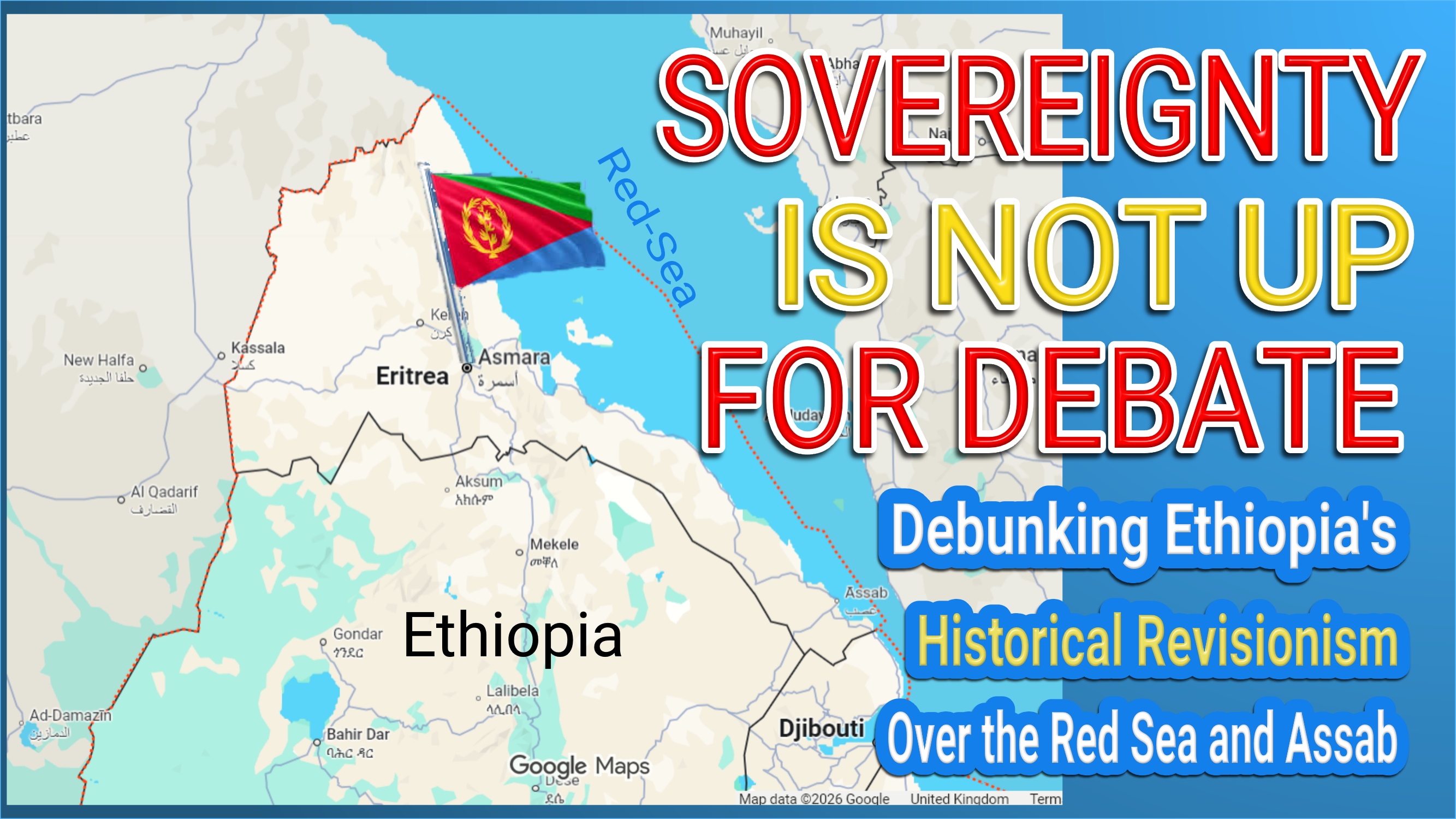
Sovereignty is Not Up for Debate: Debunking Ethiopia's Historical Revisionism Over the Red Sea and Assab.
By Dr. Negassi Hadgu.
March 12, 2026
Abstract
In recent times, a coordinated narrative has emerged from Ethiopian authorities and commentators, asserting a historical or strategic claim to the Red Sea coast, particularly the Eritrean port of Assab. Presented as a corrective to geographical "injustice," this rhetoric reflects a clear disregard for international law and established historical facts. For Eritreans, especially those in the democratic opposition advocating for the rule of law and human rights against the authoritarian People's Front for Democracy and Justice (PFDJ) these claims impose a profound dilemma: a dual struggle to dismantle internal oppression while defending national sovereignty against external expansionism.
This manuscript systematically debunks Ethiopia's claims on historical and legal grounds, drawing on primary treaties, international legal precedents, and contemporary policy analysis. It further demonstrates that Ethiopia's territorial rhetoric is not only legally invalid but strategically self-defeating, as it simultaneously alienates Eritrean democratic voices and strengthens the very authoritarian regime it claims to oppose. Finally, it outlines a viable framework for economic partnership predicated on unequivocal respect for Eritrean territorial integrity, proving that sovereignty and cooperation are not mutually exclusive.
The central message is unequivocal: Eritrea's borders are sealed by history, affirmed by international law, and paid for by the sacrifices of its people. They are not, and will never be, up for negotiation. But partnership remains possible, if Ethiopia affirms our territorial integrity first.
1. Introduction: A Geopolitical Threat to the Horn of Africa
The sovereignty of a nation is not a commodity to be bartered based on its neighbors' economic imperatives. Yet a systematic and coordinated campaign by Ethiopian political and military leaders seeks to challenge the very legitimacy of Eritrea's internationally recognized borders. Prime Minister Abiy Ahmed has publicly described the Red Sea as an "existential issue" and "the natural border of Ethiopia," declaring that if sea access is not achieved during his tenure, the next generation must make it a reality (Reuters 2023; Red Sea Task Force 2025, p. 1). This dangerous vision is institutionally echoed by Chief of Staff General Berhanu Jula, who appeared before the Ethiopian Parliament's Foreign Relation and Peace Affairs Standing Committee on June 12, 2025, explicitly stating that "relentless effort is underway to work in cooperation with the countries in the region to secure sea access to Ethiopia" and highlighting the deliberate revival of a naval force (Borkena 2025).
This is not isolated rhetoric. It is a coordinated, institutional message delivered across political, military, and administrative domains (Red Sea Task Force 2025). For Eritreans and the international community committed to stable post-colonial borders, these assertions are legally invalid, historically unsubstantiated, and regionally destabilizing.
I write as an Eritrean scholar and democratic opposition member, committed to the rule of law, human rights, and the eventual eradication of the People's Front for Democracy and Justice (PFDJ)'s authoritarian grip on Eritrea, a regime widely condemned for indefinite conscription, suppression of civil liberties, and systematic human rights abuses (Human Rights Watch 2023; UN Human Rights Council 2016). When Abiy Ahmed came to power in 2018, accepted the Eritrea-Ethiopia Boundary Commission (EEBC) ruling, and earned the Nobel Peace Prize, I celebrated alongside millions (BBC News 2019; International Crisis Group 2020). That hope has been profoundly betrayed.
Ethiopia's territorial rhetoric has placed Eritrean democrats in an untenable position: we are now fighting on two fronts simultaneously, dismantling internal oppression while defending our nation's existence. My position is clear: there must be an Eritrea to save first.
The following sections demonstrate why Ethiopia's claims to the Red Sea coast cannot withstand historical, legal, or strategic scrutiny.
2. Historical Analysis: A Rejection of Ethiopian Revisionism
2.1 The Historical Fact: Modern Ethiopia Was Born Landlocked
Ethiopian revisionists frequently invoke ancient empires particularly the Aksumite Kingdom to legitimize coastal claims. However, contemporary statehood is defined by 19th and 20th-century treaties and administrative realities, not pre-colonial legacies. The historical evidence confirms unambiguously that modern Ethiopia accepted its landlocked status from its very formation as a modern state.
2.2 The Acquisition of Assab: A Transaction Beyond Ethiopian Control
The establishment of Assab as an Italian foothold was not an encroachment on Ethiopian-administered territory. On November 11, 1869, the Italian Rubattino Shipping Company, acting as a proxy for Italian colonial interests, acquired the port of Assab and surrounding lands from the local Afar ruler, the Sultan of Raheita, for 8,100 Maria Theresa Dollars (Longrigg 1945; Negash 1987). Italian troops subsequently formalized control with a significant landing in January 1882, solidifying Assab as the first Italian colonial possession on the Red Sea coast (Longrigg 1945).
This transaction was conducted entirely with local Afar rulers not with the central Ethiopian state because the Ethiopian empire lacked direct administrative authority over the Red Sea coast at that time. The coast was governed by indigenous Afar sultans who were the legitimate local authorities. This single historical fact devastates the foundational premise of Ethiopian revisionism: Assab was never an Ethiopian-administered territory to be colonized away from Ethiopia.
2.3 Menelik II's Formal Recognition of Italian Eritrea
Emperor Menelik II, the architect of the modern Ethiopian state, explicitly and repeatedly acknowledged Italian sovereignty over Eritrea through binding international treaties. The Treaty of Wuchale (1889) delineated a formal boundary between independent Ethiopia and Italian Eritrea (Bahru Zewde 2002). Although the treaty later generated controversy due to discrepancies between its Amharic and Italian versions regarding Ethiopian sovereignty, it unequivocally served to delineate Italian control over Eritrean territory, including Assab (Bahru Zewde 2002).
More significantly, following Ethiopia's celebrated and historic victory at the Battle of Adwa in 1896, a victory that preserved Ethiopian independence and delivered a decisive blow to Italian ambitions in the highlands Menelik II chose not to extend the liberation to the Eritrean coast. The subsequent Treaty of Addis Ababa (1896) reaffirmed the boundaries of Italian Eritrea (Bahru Zewde 2002; Negash 1987). Ethiopia, at the height of its military power and diplomatic leverage, deliberately chose inland consolidation over coastal reclamation. He did not defend the coast because it was not considered his to defend. Ethiopia accepted the existence of a distinct Eritrean territory under Italian rule for over half a century, until Italian colonial administration ended in 1941 during World War II (Bahru Zewde 2002; Negash 1987; Longrigg 1945).
The conclusion is inescapable: modern Ethiopia did not "lose" the sea through Eritrean independence. It was legally established as a landlocked state by its own Emperor's deliberate choices.
2.4 A Contradiction in Narratives: The "Uncolonized" State and Its Colonial Gateway
Ethiopia's proud history of resisting European colonization is a legitimate source of national identity. However, it is historically and morally incoherent to invoke that anti-colonial legacy to support territorial claims on the Eritrean coast. Assab is, above all, the symbol and gateway of Eritrea's colonization (Longrigg 1945; Negash 1987). For Ethiopia to now claim this port by invoking its anti-colonial narrative is a contradiction of the highest order. If Assab was truly Ethiopian, why did Ethiopia not contest its acquisition in 1869? Why did it not fight to recover it after Adwa in 1896, when it had every opportunity to do so? The answer, supported consistently by the historical record, is straightforward: it was not considered Ethiopian territory (Bahru Zewde 2002; Negash 1987).
2.5 Annexation as Occupation: The Thirty Year’s Struggle for Liberation (1961–1991)
The brief period when Ethiopia controlled Assab, from 1952 to 1991, was not a legitimate exercise of sovereignty but an era of illegal annexation that violated the UN-brokered federation (United Nations General Assembly 1950). When Emperor Haile Selassie unilaterally dissolved the federation and annexed Eritrea in 1962, he triggered one of Africa's longest and most devastating liberation wars. For the Eritrean people, this was not governance, it was a second colonization (Iyob 1995; Pool 2001; Connell 1997). The 30-year armed struggle of the Eritrean People's Liberation Front was a war of national liberation to end that occupation (Iyob 1995; Pool 2001). To cite this era of illegal annexation as a basis for modern territorial claims is to disregard the historical legitimacy of Eritrea's liberation struggle and to insult the memory of those who gave their lives for freedom.
| Year | Event | Source |
|---|---|---|
| 1869 | Italy purchases Assab from Afar Sultan | Longrigg 1945 |
| 1882 | Italian troops formalize control of Assab | Longrigg 1945 |
| 1889 | Treaty of Wuchale recognizes Italian Eritrea | Bahru Zewde 2002 |
| 1896 | Battle of Adwa; Treaty of Addis Ababa reaffirms borders | Negash 1987 |
| 1941 | Italian colonial rule ends | Negash 1987 |
| 1950 | UN Resolution 390(V) federates Eritrea with Ethiopia | UN General Assembly 1950 |
| 1962 | Ethiopia illegally annexes Eritrea | Iyob 1995 |
| 1991 | EPLF liberates Eritrea | Pool 2001 |
| 1993 | UN admits Eritrea as sovereign member state | UN Security Council 1993 |
| 2002 | EEBC delimits final borders | EEBC 2002 |
| 2018 | Ethiopia accepts EEBC ruling under Abiy Ahmed | ICG 2020 |
| 2023-present | Ethiopian leaders revive sea access and Assab rhetoric | Reuters 2023; Borkena 2025 |
3. The Legal Framework: Eritrea's Sovereignty is Ironclad
3.1 The Principle of Uti Possidetis Juris
The cornerstone of African post-colonial stability is the legal principle of uti possidetis juris, the doctrine that newly independent states inherit the colonial administrative borders that existed at the moment of independence (International Court of Justice 1986; Shaw 2017). This principle was formally enshrined by the Organization of African Unity's landmark 1964 Cairo Declaration, which committed all African states to respect inherited colonial frontiers to prevent the continent from descending into endless territorial conflict (Organization of African Unity 1964).
The borders of Eritrea, encompassing Assab and Massawa, were clearly defined and legally established during the Italian colonial period (1890s–1941). When Eritrea achieved independence in 1993, it inherited those exact borders under this foundational doctrine. The International Court of Justice affirmed uti possidetis juris decisively in the Burkina Faso–Mali Frontier Dispute (1986), ruling that preserving colonial borders is essential to maintaining stability in newly independent states (International Court of Justice 1986). Ethiopia's appeals to ancient historical influence are legally irrelevant, international law categorically favors precise colonial demarcations over ambiguous pre-colonial spheres of influence (Shaw 2017).
3.2 The Right to Self-Determination: A Right Paid for in Blood
The right to self-determination is a foundational principle of the modern international order, enshrined in the Charter of the United Nations (United Nations 1945). The Eritrean people did not merely claim this right; they fought for it for thirty years at immeasurable cost in human life and suffering (Iyob 1995; Pool 2001; Connell 1997). They then formally exercised it in April 1993, when a UN-supervised referendum produced a result of 99.8% in favor of full independence (United Nations 1993). This was one of the most decisive expressions of self-determination in African history.
The United Nations subsequently admitted Eritrea as a sovereign member state (United Nations Security Council 1993), and Ethiopia formally recognized Eritrea's independence and borders. Any territorial claim on Assab is not merely a legal violation, it is a direct assault on the democratic will of an entire people and a fundamental right enshrined in international law (United Nations 1945; United Nations 1993).
3.3 Ethiopia's Own Commitments: Recognition and Reversal
Ethiopia's legal obligations are particularly strong given its own prior commitments. In 1993, Ethiopia formally recognized Eritrean sovereignty. Following the devastating Eritrean-Ethiopian War (1998–2000), both nations submitted to binding international arbitration, and the Eritrea-Ethiopia Boundary Commission (EEBC) issued its final delimitation decision in 2002 (Eritrea-Ethiopia Boundary Commission 2002). In 2018, in what was celebrated internationally as a historic breakthrough, Prime Minister Abiy Ahmed accepted the EEBC ruling, earning him the Nobel Peace Prize (BBC News 2019; International Crisis Group 2020).
For Ethiopian officials to now question Eritrean sovereignty represents a fundamental reversal of solemn international commitments. It undermines the credibility of the 2018 peace agreement, destabilizes the region, and makes Ethiopia an unreliable partner in the eyes of the international community (International Crisis Group 2020; Red Sea Task Force 2025).
4. A Self-Defeating Strategy: How Ethiopia Strengthens the PFDJ
From the perspective of an Eritrean democrat who has dedicated their life to opposing the PFDJ's authoritarian rule, Ethiopia's current strategy is profoundly and tragically self-defeating.
The most natural and powerful allies for Ethiopian aspirations of a peaceful, economically integrated Horn of Africa are Eritrean opposition scholars, activists, journalists, and civic leaders who oppose the PFDJ's isolationism, militarism, and repression. We have consistently advocated for democratic governance, regional integration, and peaceful cooperation. We represent the Eritrean future that Ethiopia claims to want as its partner.
Yet, by openly and institutionally threatening Eritrean sovereign territory, Ethiopia has made it impossible for us to engage with its government. The coordinated messaging from Prime Minister Abiy Ahmed, Chief of Staff General Berhanu Jula, and Ethiopian political elites (Red Sea Task Force 2025; Borkena 2025; Reuters 2023) has handed a massive and unearned propaganda victory to the PFDJ regime. It allows Asmara to frame its indefinite national service, suppression of political opposition, and restriction of civil liberties as a necessary national defense against an existential external threat (International Crisis Group 2020; Human Rights Watch 2023; UN Human Rights Council 2016). The PFDJ, which might otherwise struggle to justify its authoritarian governance, is now able to mobilize genuine Eritrean patriotism in its defense patriotism that Ethiopian rhetoric has deliberately provoked (Connell 1997; International Crisis Group 2020).
This is not a peripheral consequence. It is a central strategic failure. Ethiopia is simultaneously:
• Alienating its most natural democratic allies within Eritrea
• Strengthening the authoritarian forces it claims to oppose
• Undermining the regional stability it claims to seek
• Violating the international legal framework it once committed to uphold
We Eritrean democrats are forced to fight on two fronts: the internal struggle for democratic reform and the external defense of national sovereignty. This dual burden weakens the democratic project and entrenches the very authoritarianism that both Eritrean and Ethiopian democrats should be working together to dismantle. Simply and powerfully stated: there must be an Eritrea to save first.
5. Economic Need Does Not Equal Territorial Rights: A Framework for Partnership
5.1 Acknowledging Ethiopia's Genuine Economic Challenges
Intellectual honesty requires acknowledging the genuine economic constraints Ethiopia faces as a landlocked nation of over 120 million people. Ethiopia currently relies on Djibouti for approximately 95% of its maritime trade (World Bank 2020; Red Sea Task Force 2025, p. 57–58). According to the World Bank (2020), landlocked countries face trade costs 50–60% higher than their coastal counterparts, translating to billions of dollars annually in additional logistics expenses. The Addis Ababa–Djibouti railway, completed in 2016, has partially alleviated pressure, but capacity constraints and delays continue to hamper Ethiopian commerce (African Development Bank 2021). Ethiopia's rapid economic growth averaging 9–10% GDP growth annually prior to COVID-19 and its large, growing population amplify the need for diversified, cost-effective trade routes (World Bank 2020). Dependence on a single port in a single neighboring country creates genuine strategic vulnerability (UNCTAD 2020).
I understand these challenges and the historical grievances that accompany them. However, understanding Ethiopia's economic needs does not equate to legitimizing territorial claims.
5.2 Regional Precedents: Landlocked Nations Thrive Without Annexation
Ethiopia is not unique in its landlocked condition. Over 40 countries worldwide manage without sovereign coastlines, many achieving significant economic development through diplomatic and commercial solutions:
• Zambia accesses global markets through bilateral port agreements with Tanzania (Dar es Salaam) and Mozambique (Beira and Nacala), without claiming sovereignty over those coastlines (UNCTAD 2020).
• Botswana utilizes Namibia's Walvis Bay through transparent commercial arrangements (World Bank 2020).
• Bolivia, despite deep historical grievances over its 19th-century loss of Pacific coastline to Chile, engages through diplomatic channels and international advocacy rather than territorial aggression (UNCTAD 2020).
• Mongolia maintains robust trade through commercial agreements with Russia and China without any territorial claims on coastal regions (World Bank 2020).
These precedents demonstrate that economic necessity and sovereign respect are entirely compatible. The path is clear: diplomacy, not annexation.
5.3 A Concrete Framework for Mutually Beneficial Partnership
My critique of Ethiopia's current policy is not a rejection of partnership. It is a demand for the only conditions under which genuine and lasting partnership can be built mutual respect for sovereignty. To demonstrate this concretely, I propose the following framework for cooperation, which could be pursued immediately following Ethiopia's unambiguous and permanent reaffirmation of Eritrean sovereignty:
a) Long-Term Port Leases
Ethiopia could negotiate a long-term commercial lease, for example, 50 to 99 years for dedicated terminal facilities at the Port of Assab. Such a lease would grant Ethiopia operational control over its designated area, including customs and logistics management, while operating strictly under Eritrean law and within a framework of clear recognition of Eritrean sovereignty (Shaw 2017). This model has international precedents and could be structured to benefit both economies.
b) Joint Infrastructure Development
Eritrea and Ethiopia could establish a joint venture, potentially with international investment from institutions such as the African Development Bank or the World Bank, to modernize and expand the Port of Assab and the transportation corridors connecting it to the Ethiopian highlands (African Development Bank 2021; World Bank 2020). Such joint development would create powerful mutual economic incentives for the success and security of the arrangement.
c) Establishment of a Free Trade Zone
designated Free Trade Zone (FTZ) in the Assab region could be established for Ethiopian, Eritrean, and international businesses, creating a vibrant economic hub that serves Ethiopia's manufacturing and export ambitions while generating significant employment opportunities and fiscal revenue for Eritrea (UNCTAD 2020; World Bank 2020).
d) International Guarantees and Binding Arbitration
To ensure durability and mutual trust, any such agreement should be mediated by a neutral party such as the African Union and its terms guaranteed by the United Nations Security Council (United Nations Security Council 1993). A clear and binding international arbitration mechanism must be incorporated to resolve any future disputes peacefully and impartially (Shaw 2017).
This framework demonstrates that Eritrea's sovereignty and Ethiopia's economic aspirations are not mutually exclusive. The Port of Assab can serve Ethiopia's needs, but only through an agreement between two sovereign equals, never through territorial coercion.
6. A Call to the International Community
The international community cannot afford to treat Ethiopia's revisionist claims as mere political rhetoric to be ignored. History has shown repeatedly that unchallenged territorial ambitions escalate into conflict. The African Union, the United Nations, and all member states that uphold the post-colonial legal order must:
• Publicly and unequivocally affirm Eritrea's sovereignty within its internationally recognized borders
• Reject any framing that presents territorial revisionism as a legitimate response to economic need
• Encourage Ethiopia to pursue sea access through the diplomatic and commercial frameworks that international law provides
• Support Eritrean democratic voices who advocate for both sovereign integrity and regional cooperation
The stability of the entire Horn of Africa a region already burdened by conflict, poverty, and displacement depends on the firm application of the principles enshrined in the OAU Cairo Declaration (1964), the UN Charter (1945), and the uti possidetis juris doctrine (ICJ 1986).
7. Conclusion
The Port of Assab is sovereign Eritrean territory. It was purchased from an Afar Sultan in 1869, not from Ethiopia. It was formally recognized as part of Italian Eritrea by Emperor Menelik II himself. It was liberated through thirty years of sacrifice by the Eritrean people. It was affirmed by a UN-supervised referendum in which 99.8% of Eritreans voted for independence. It was recognized by Ethiopia and the entire international community. And it was legally delimited by the binding EEBC ruling that Ethiopia itself accepted in 2018.
Ethiopia's attempts to rewrite this history to justify territorial expansionism represent a clear and present danger to the stability of the entire Horn of Africa. These claims fail on every level: historically, legally, diplomatically, and strategically. They do not represent the aspirations of a responsible regional power. They represent a retreat from the rule of law into dangerous revisionism.
My message to the Ethiopian government is direct: if you genuinely seek a future of peace, prosperity, and regional integration, the path is clear. Publicly, unambiguously, and permanently reaffirm your recognition of Eritrean sovereignty within its internationally recognized borders. Commit to negotiating sea access through the sovereign commercial frameworks that international law provides. And commit to working with Eritrean democrats, those of us who fight for a free Eritrea, a nation where liberty and freedom are the air we breathe, where justice is the ground, we stand on, and where every Eritrean can realize their full potential in a land of peace and prosperity.
Until that day, we Eritrean democrats are bound by conscience, by patriotism, and by historical necessity to defend our nation's sovereignty with the same determination that our people have always shown. We are committed to building a democratic Eritrea. But we know, with absolute and unshakeable certainty, that there must be an Eritrea to save first.
Eritrea's borders are sealed by history, affirmed by international law, and paid for by the immense and irreplaceable sacrifices of its people. They are not, and will never be, up for negotiation.
REFERENCES
- 1. African Development Bank. 2021. "Transport Infrastructure and Trade Facilitation in the Horn of Africa." Abidjan: AfDB.
- 2. Bahru Zewde. 2002. A History of Modern Ethiopia, 1855–1991. 2nd ed. Oxford: James Currey.
- 3. BBC News. 2019. "Ethiopia's Abiy Ahmed Wins Nobel Peace Prize." October 11, 2019.
- 4. Borkena. 2025. "Ethiopian Defense Chief Says Ethiopia Working to Secure Sea Access." June 12, 2025.
- 5. Connell, Dan. 1997. Against All Odds: A Chronicle of the Eritrean Revolution. Lawrenceville, NJ: Red Sea Press.
- 6. Eritrea-Ethiopia Boundary Commission (EEBC). 2002. Decision Regarding Delimitation of the Border between the State of Eritrea and the Federal Democratic Republic of Ethiopia. The Hague: Permanent Court of Arbitration.
- 7. Human Rights Watch. 2023. "Eritrea: Events of 2023." World Report 2024. New York: HRW.
- 8. International Court of Justice (ICJ). 1986. Case Concerning the Frontier Dispute (Burkina Faso/Republic of Mali). ICJ Reports.
- 9. International Crisis Group. 2020. "Ending Ethiopia and Eritrea's Dangerous Deadlock." Africa Report No. 296. Brussels: ICG.
- 10. Iyob, Ruth. 1995. The Eritrean Struggle for Independence: Domination, Resistance, Nationalism, 1941–1993. Cambridge: Cambridge University Press.
- 11. Longrigg, S. H. 1945. A Short History of Eritrea. Oxford: Oxford University Press.
- 12. Negash, Tekeste. 1987. Italian Colonialism in Eritrea, 1882–1941: Policies, Praxis and Impact. Uppsala: Uppsala University Press.
- 13. Organization of African Unity (OAU). 1964. "Resolution on the Intangibility of Frontiers, AHG/Res. 16(I)." Cairo: OAU.
- 14. Pool, David. 2001. From Guerrillas to Government: The Eritrean People's Liberation Front. Oxford: James Currey.
- 15. Red Sea Task Force. 2025. "Eritrean Sovereignty and Ethiopia's Quest for Sea Access: Work Product of the Red Sea Task Force." March 2025.
- 16. Reuters. 2023. "Eritrea Accuses Ethiopia of 'Warmongering' Over Red Sea Port Access." December 22, 2023.
- 17. Shaw, Malcolm N. 2017. International Law. 8th ed. Cambridge: Cambridge University Press.
- 18. UN Human Rights Council. 2016. "Detailed Findings of the Commission of Inquiry on Human Rights in Eritrea." A/HRC/32/CRP.1. Geneva: UN.
- 19. UNCTAD. 2020. "The Costs of Being Landlocked: Logistics Costs and Supply Chain Reliability in Sub-Saharan Africa." Geneva: United Nations Conference on Trade and Development.
- 20 United Nations. 1945. Charter of the United Nations. San Francisco: UN.
- 21. United Nations. 1993. Report of the United Nations Observer Mission to Verify the Referendum in Eritrea (UNOVER). A/48/280.
- 22. United Nations General Assembly. 1950. Resolution 390(V): "Eritrea: Report of the United Nations Commission for Eritrea; Report of the Interim Committee of the General Assembly on the Report of the United Nations Commission for Eritrea." A/RES/390(V).
- 23. United Nations Security Council. 1993. Resolution 828: "Admission of Eritrea to Membership in the United Nations." S/RES/828.
- 24. World Bank. 2020. "Ethiopia Economic Update: Overcoming Constraints to Trade." Washington, DC: World Bank Group.
Victory and glory to the Eritrean people.
God Bless Eritrea and its people.
March 12, 2026
Read in PDF ብ'PDF ንምንባብ ኣብዚ ጠውቑ።
See also more articles by Dr. Negassi Hadgu
ካልኦት ብ'ዶር ነጋሲ ሓድጉ ዝተጻሕፉ ጽሑፋት ኣብ ታሕቲ ተወከሱ:-
ልዑላውነት ኤርትራን ሕቶ ኣፍደገ-ባሕሪ ኢትዮጵያን፡
Eritrean Sovereignty and Ethiopia's quest for Red-Sea Access.
Part-1/5 (English):
Part-2/5 (Tigrinya):
Part-3/5 (Amharic):
Part-4/5 (Arabic):
Part-5/5 (Q and A ሕቶን መልስን):
ተወሰኽቲ ሰሚናራት፡ ብኣባላት ናይዚ ጉጅለ መጽናዕቲ፡ ኣብዚ ታሕተዋይ ሊንክ ጠውቑ፡-
See also more media interviews by the Red Sea Task Force, below:-
1 - Dehay Eritrea ምሁራት ኤርትራ ብዛዕባ ሕቶ ኣፍደገ ባሕሪ እንታይ እዮም ኣጽኒዖም? ደሃይ ኤርትራ
2 - Atv Asena Live: ኢትዮጵያ ዋንነት ቀይሕ ባሕሪ ኤርትራ ብውዲ ወይ ብግዲ ምባላ ርትዓዊ ድዩ? - ዘተ ምስ መጽናዕቲ ዘካየዱ ኣባላት ሓይሊ ዕማም ኤርትራ
3 - ዘተ ብኤርትራውያን ምሁራት ሓይሊ ዕማም ቀይሕ ባሕሪ ኣብ ዝቐረበ መጽናታዊ ጽሑፍ
 ብተወሳኺ፡ ነቲ ኣብ ዩቱብ ቻነል ዝወጽእ ሓበሬታ፡ ንመትከላት ማሕበራዊ መትከላት ዩቱብ (YouTube Community Guidelines)፡ እናኽበረ የውጽእ። ስኒትና፡ ብዝከኣሎ መጠን፡ ነዚ መትከላት'ዚን ናይ ሃገርና ኤርትራን ህዝባን ክዉንነትን ምርኩስ ገይሩ፡ ኣብ መርበብ ሓበሬታኡ ስኒትና (www.snitna.com) ክውጽእ ዝግብኦ ሓበሬታ እናመመየ ከውጽእ ይህቅንን ይጽዕርን። እዚ ስራሕዚ ምሉእ ዓወት ንክህልዎ ድማ ብዓቢኡ፡ ግቡእ ኣጠቓቕማ ተሳተፍቲን ምትሕብባርን ምስዝህሉ ኢዩ። ስለዚ፡ ነዚ መትከላት ዚ ንምኽባር ንኹሉ ተገልጋላይ'ዚ መርበብዚ ንጽውዕ። ዝኾነ ሃሳዪ ተርእዮታት ምስዘጋጥሙ፡ ቅሬታኹም ወይ ርእይቶኹም ብኢመይል ኣድራሻና ኣቢልኩም ክትልእኩልና ንላቦ።
 See also Related / ምስዚ ዝተኣሳሰር ሓበሬታ፡-
- Snitna YouTube - ስኒትና ዩቱብ ቻነል።
- Snitna Network and Sinit Seminars Directory. ብ`ስኒትና ከምኡ`ውን ስኒት ዝተኻየዱ ሰሚናራት።
- Snitna FaceBook - ስኒትና ፌስቡክ።
- Sinit YouTube - ስኒት ዩቱብ ቻነል።
- ዘተ ንሓባራዊ ንቕሓት
Dialogue for Common Awareness
مجموعة الحوار للوعي المشترك - ሌላ ምስ
ፖለቲካዊ ሰልፍታትን ህዝባዊ ምንቅስቓሳትን ኤርትራ፡
Eritrean Political parties and Civic movements.s
مقدمة في الأحزاب السياسية والحركات المدنية الإريترية - BUILDING DEMOCRACY IN ERITREA - ህንጸት ዲሞክራሲ ኣብ ኤርትራ بناء الديمقراطية في إريتريا
- ሕግን ሕብረተሰብን - Law and Society.
- ኣስተምህሮ፡ መስርሕ ምንዳፍ ቅዋም ኤርትራ - The Eritrean Constitution Making Process
Seminar by Dr Bereket Habte selassie. ኣስተምህሮ፡ ብ`ዶር. በረኸት ሃብተስላሰ። - ሲምፖዝዩም ኤርትራ (Eri-Platform: 2018 - 2020)
- ዋዕላ ህንጸት ዲሞክራሲ ኣብ ኤርትራ Building Democracy in Eritrea Conference (Eritrea Focus: 2019 - 2020)
- Enough is enough! ይኣክል ምልኪ! ማዕበል ድምጺ ህዝቢ لقد طفح الكيل
- 1993, Eritrean independence referendum Results
ታሪኻዊ ውጽኢት ረፈረንዱም ኤርትራ 1993. - ሃገራዊ ቻርተር ኤርትራ - ኣብ 3ይ ጉባኤ ህ.ግ.ሓ.ኤ: ዝጸደቐ (ናቕፋ 10 - 16 ለካቲት 1994)።
- PFDJ NATIONAL CHARTER Adopted by the 3rd Congress of the EPLF/PFDJ Naqfa, February 10-16, 1994.
- ንዝኽሪ ግዳያት ዲክታቶሪያዊ ምሕደራ ኤርትራ። In memory of Victims of Dictatorial Administration in Eritrea.
- G-15:- ቅልዕቲ ወረቐት ናብ ህዝቢ ኤርትራ፡ ኣገደስቲ እዋናውያን ጉዳያት፡ (ኣስመራ፡ ነሓሰ 3፡ 2001)
- G-15:-Open Letter To The People of Eritrea (Asmara, August 3, 2001)
- G-15:-ቅሉዕ መልእኽቲ ናብ ኩሎም ኣባላት ህግደፍ
- G-15:-Open Letter to All PFDJ Members (Audio) ቅሉዕ መልእኽቲ ናብ ኩሎም ኣባላት ህግደፍ (ብድምጺ)
- G-15:-Open Letter to All PFDJ Members
- GI: ህጹጽ ጻውዒት ንኹሎም ኣብ መላእ ኵርናዓት ዓለም ዝርከቡ ኤርትራውያን። An Urgent Call to All Eritreans Worldwide. المبادرة العالمية لتمكين الحركة الشعبية الاريترية
- ድምጽና (Our Voice)
- መደብ ንጋባእ ENGAGE ERITREA!
- Advice for All Eritreans ምኽሪ ንኹሎም ኤርትራውያን
- UN Human Rights Council - Human Rights in Eritrea (Website) / ናይ ውሕሃ ቤትምኽሪ ሰብኣዊ መሰላት - ኩነታት ሰብኣዊ መሰላት ኣብ ኤርትራ፡ (Website)
- UN Human Rights Council - Human Rights in Eritrea (YouTube) / ናይ ውሕሃ ቤትምኽሪ ሰብኣዊ መሰላት - ኩነታት ሰብኣዊ መሰላት ኣብ ኤርትራ፡ (YouTube)
- Human Rights in Eritrea / ኩነታት ሰብኣዊ መሰላት ኣብ ኤርትራ፡
- UN - Commission of inquiry on Eritrea / ናይ ውሕሃ መርማሪት ኮሚሽን ሰብኣዊ መሰላት ኤርትራ፡
- Mike Smith / ሚስተር ማይክ ስሚዝ፡ ኣቦ ወንበር መርማሪት ኮሚሽን ሰብኣዊ መሰላት ኤርትራ፡
- Also see: "UN - COI on Eritrea / ናይ ውሕሃ መርማሪት ኮሚሽን ሰብኣዊ መሰላት ኤርትራ፡
- UN COMMISSION OF INQUIRY ERITREA (COI-ERITREA) And POPULAR RESPONSES
- ጸብጻብ መርማሪት ኮሚሽን ሰብኣዊ መሰላት ኤርትራ፡ ህዝባዊ ግብረ-መልሲን
- ጸብጻብ መርማሪት ኮምሽን ኵነታት ሰብኣዊ መሰላት ኣብ ኤርትራ – ዘይወግዓዊ ትርጉም (ብትግርኛ)