

08/05/2026 01:32 AM
The Shattered Cage:
Anomie, Trauma, and the Crisis of the Eritrean Diaspora
by Dr. Gebre Gebremariam
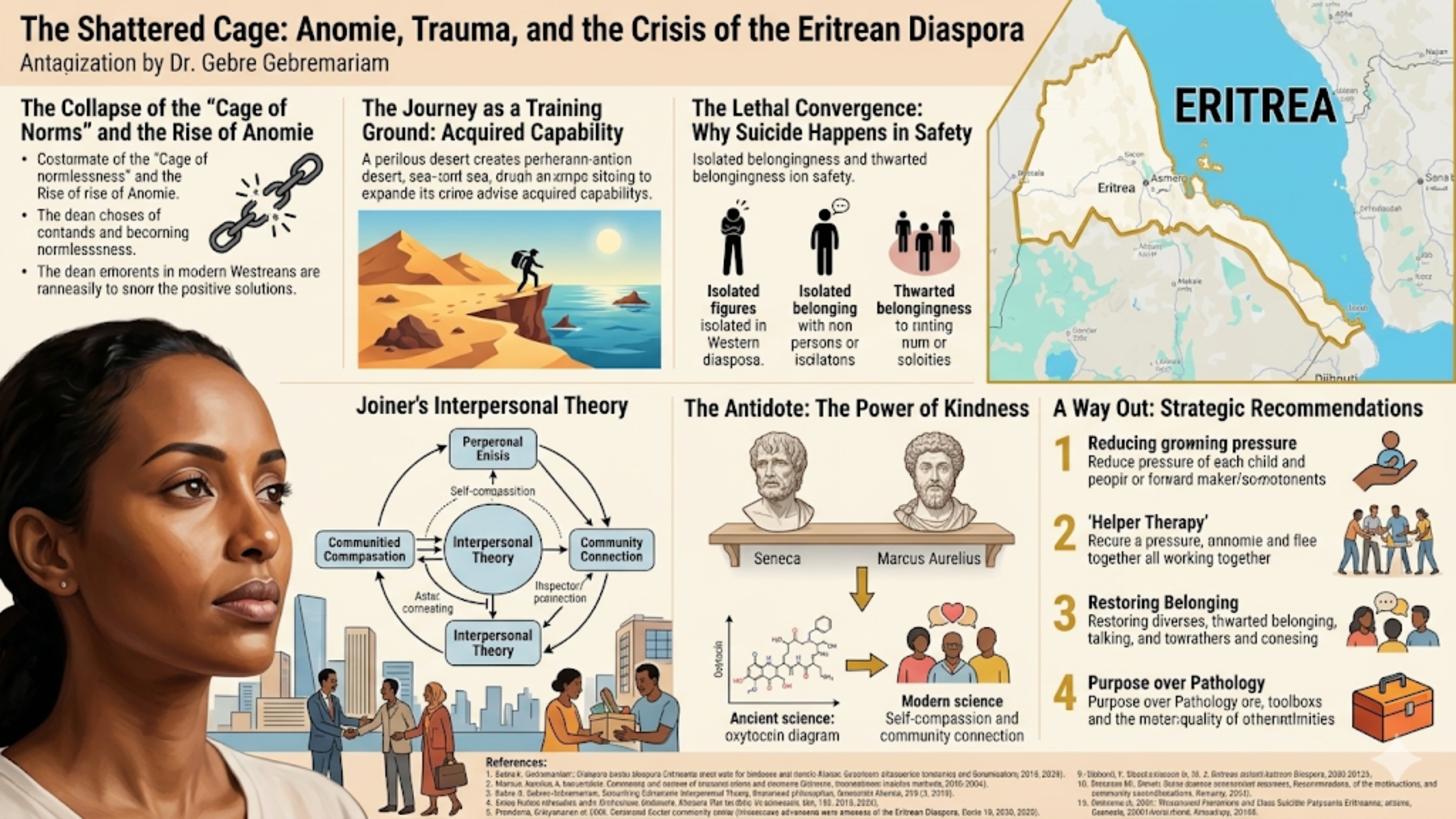
The Shattered Cage: Anomie, Trauma, and the Crisis of the Eritrean Diaspora.
Dr. Gebre Gebremariam
The Context: A Systemic Dismantling
For over three decades, the social fabric of Eritrea has undergone a systematic dismantling. In traditional Eritrean society, a robust framework of cultural and moral values – what I have termed the “Cage of Norms” – governed behavior. This structure created a predictable, regulated environment where familial bonds were paramount and extreme violence, such as homicide and suicide, was virtually unheard of. However, under the dictatorial regime of Issaias Afeworki, this structure has been assaulted. Through the forced conscription of school-age children and indefinite national service, the regime has severed the continuity of family life.
The current reality is a tragic paradox: young people who successfully navigated one of the most dangerous migration routes in the world – crossing the Sahara, Sinai, and the Mediterranean – are succumbing to suicide upon reaching physical safety in Western nations. To understand this, we must look beyond the simplified label of “depression” and view this crisis as a systemic collapse of social integration. In my analysis, The Vicious Cycle of Criminality, I argue that the destruction of these norms has created a vacuum where the youth, disconnected from their traditional socialization, face a profound state of social anomie (Gebremariam 2025, 4). This article integrates sociopsychological frameworks with the historical philosophy of kindness to explain this phenomenon and propose a strategic way out of this quagmire.
The Collapse of the “Cage of Norms” and the Rise of Anomie
The foundational cause of the current crisis is the regime’s destruction of the traditional socialization process. As I have noted, the “Cage of Norms” has sustained a “continued assault by the dictatorial regime of Issaias Afeworki for over three decades” (Gebremariam 2025, 4). By removing children for summer service and conscripting adolescents into indefinite military training, the state has usurped the role of the parent. The family, the primary unit of social regulation, has been rendered impotent.
Sociologically, this state of affairs mirrors Emile Durkheim’s concept of anomie. Whitney Pope, in his analysis of Durkheim, explains that society acts as a regulatory force; when that power is disturbed, “the scale is upset; but a new scale cannot be immediately improvised” (Pope 1982, 34). In Eritrea, the traditional scale was destroyed, but it was replaced not by a functional new morality, but by arbitrary cruelty and servitude. This leads to a state of “deregulation” or normlessness (Lester 1994, 28). Consequently, as I observed, “traditional norms have been undermined, and people have started to live normlessness for quite some time” (Gebremariam 2025, 6). When a generation grows up without the “Cage of Norms” to guide them, boundaries regarding the sanctity of life – both their own and others – begin to dissolve.
The Journey as a Training Ground: Acquired Capability
The consequences of this domestic collapse are migration and victimization. However, the journey itself plays a sinister role in the suicide epidemic. According to the Interpersonal Theory of Suicide by Thomas Joiner, humans are naturally afraid of pain and death. To commit suicide, one must possess the “acquired capability” to overcome this fear, usually through exposure to pain, violence, or trauma (Joiner 2007, 62).
The Eritrean refugee experience acts as a training ground for this capability. While crossing the Great Deserts and deep seas, these youths faced severe refugee camp conditions and exposure to human trafficking networks. Many were subjected to inhumane treatments by captors who demanded hefty ransoms, while others witnessed or were subjected to organ-harvesting schemes. A young person who has survived the torture camps of the Sinai, dehydration in the Sahara, or near-drowning in the Mediterranean has a dangerously high tolerance for pain and a reduced fear of death. As I have argued, this trauma creates a “vicious cycle” where the threshold for violence is lowered (Gebremariam 2025, 7).
The Lethal Convergence: Why Suicide Happens in Safety
Upon reaching the diaspora, one might expect relief; instead, we witness a disturbing rise in suicide, spousal murder, and intra-community violence. Using Joiner’s framework, we can identify two other specific factors that converge with acquired capability to produce lethal outcomes: Thwarted Belongingness and Perceived Burdensomeness (Joiner 2005, 46).
Thwarted Belongingness (Isolation):
In Eritrea and during the migration journey, survival depended on the collective. However, in the “Third Country” (the host nation), the youth face immediate atomization. They are often placed in individual housing or scattered across cities, facing the shocks of racism and cultural alienation. They feel they do not belong to the host culture, and due to political fragmentation, they often feel disconnected from the established diaspora community. This aligns with John Berry’s concept of “marginalization,” the most stressful acculturation path where individuals lose contact with their origin culture and fail to participate in the host culture (Berry 2005, 705).
Perceived Burdensomeness (Pressure):
This is perhaps the most critical factor regarding family pressure. Young refugees often carry the financial debt of their journey, including ransom payments and smuggler fees. Families back home, often unaware of the high cost of living or the difficulty of the labor market in the West, expect immediate financial support. When the young person cannot meet these demands, they internalize a sense of failure. They feel they are a “burden” to the family they promised to save, leading to the false belief that “my death will be worth more to others than my life.”
The Antidote to Anomie: The Power of Kindness Through History and Science
While the breakdown of norms explains the cause, the solution lies in reconstructing the social fabric. To do this, we must turn to a resource recognized throughout history: the formidable power of Kindness. Far from a soft or passive virtue, kindness has long been understood by philosophers as the essential glue of a sane society.
The ancient Stoics, such as Seneca and Marcus Aurelius, argued that humans are made for cooperation, much like feet, hands, and eyelids. To the Stoics, kindness (or philanthropia) was a rational duty; acting against one another is contrary to nature. Similarly, the Epicureans viewed kindness and friendship not merely as pleasantries, but as prerequisites for ataraxia – the freedom from fear and anxiety. They understood that without the security of benevolent relationships, the human mind collapses into paranoia and despair.
This ancient wisdom is supported by modern insights. In her seminal work, Kindness: Develop the Power of Compassion for Health and Happiness, Raje S. Airey situates kindness as a dynamic force that heals both the giver and the receiver. Airey argues that compassion is not just an emotion but a practice that can “improve your health, your relationships and your peace of mind” (Airey 2008, 12). For the traumatized Eritrean youth, kindness is the biological and sociological intervention required to counter the effects of anomie.
1. External Kindness: Disrupting Isolation and Violence
The rise in violence within the diaspora – including spousal murder and harming family members – is a symptom of extreme social atomization. When the “Cage of Norms” is broken, the sense of obligation to others disappears. Social psychologist Sonja Lyubomirsky has demonstrated that “Random Acts of Kindness” are potent psychological interventions that increase social connection and well-being (Lyubomirsky 2007, 125).
For the Eritrean diaspora, performing acts of kindness is the method by which the “Cage” is rebuilt. When a community member performs an act of kindness – such as offering mentorship, financial aid without repayment, or simple social inclusion to a new arrival – it disrupts the trajectory of Thwarted Belongingness (Joiner 2005). These acts release oxytocin in both the giver and the receiver, fostering trust. By re-establishing a culture of reciprocal care, the impulse to harm oneself or others is mitigated by a renewed sense of communal obligation.
2. Internal Kindness: Self-Compassion as a Shield
The suicide crisis is often driven by a harsh internal critic – a voice of shame that tells the youth they are “burdens” or “failures” for not supporting their families enough. To combat this, we must introduce the concept of Self-Compassion. Dr. Kristin Neff defines this as treating oneself with the same kindness one would offer a friend, involving self-kindness, common humanity, and mindfulness (Neff 2011, 41).
In the context of Eritrean refugees, self-compassion is a survival skill. It allows the individual to acknowledge their trauma without being consumed by it. If a young man can extend kindness to himself – realizing that his struggle is a result of a dictatorship and global inequities, not personal failure – he is less likely to view himself as a burden. Furthermore, research suggests that those who practice self-compassion are less likely to project aggression onto intimate partners (Neff 2011). Therefore, teaching self-kindness is a direct intervention against both suicide and domestic homicide.
The Crisis of “Dual Presence” and the Anxious Generation
Modern technology exacerbates these psychological wounds. Sociologists refer to the migrant experience as “Dual Presence” – being physically in one place but mentally in another.
• Physical Reality: The youth is in a low-income apartment in a Western city, facing cold weather and isolation.
• Digital Reality: Through the phone, they are mentally living in the crisis back home. They receive real-time updates of suffering, voice notes of crying relatives, and guilt-inducing messages.
Consequently, they never fully “arrive” in the safety of the Third Country. Their brains remain in the “Red Zone” (fight or flight) of the journey. Jonathan Haidt’s research on the “rewiring of childhood” is highly relevant here. He argues that trauma healing requires embodied safety – physical touch, communal eating, and face-to-face reassurance. However, the modern refugee experience is “phone-based” (Haidt 2024, 112). The youth retreat into screens to numb their pain, but social media algorithms amplify their despair by showing curated images of other “successful” Eritreans, widening the gap between their reality and expectations. Furthermore, due to time zone differences with East Africa, many youth live nocturnally to communicate with home, destroying their circadian rhythms and emotional regulation (Haidt 2024).
A Way Out: Strategic Recommendations
Breaking this “Vicious Cycle of Criminality” and addressing the suicide crisis requires a multi-dimensional approach that moves beyond simple clinical treatment. As I have emphasized, the solution must address the root causes of this “traumatized society” (Gebremariam 2025).
Phase 1: Breaking the “Burdensomeness” (Family & Finance)
To reduce the lethal pressure of Perceived Burdensomeness, the diaspora leadership must launch a public education campaign directed at Eritrean families in Eritrea and other parts of Africa. Utilizing radio and satellite TV, the message must be clear: “Pressure kills. The journey is not a lottery ticket. Give your children time to stand before asking them to carry you.” Simultaneously, host countries should provide financial literacy training that includes assertiveness training – teaching refugees how to say “No” to remittances is a vital suicide prevention strategy.
Phase 2: Operationalizing Kindness (The “Helper Therapy” Principle)
To combat the feeling of uselessness (Perceived Burdensomeness), we should utilize Frank Riessman’s “Helper Therapy Principle,” which suggests that people help themselves most when they are helping others (Riessman 1965, 27). Community programs should enlist struggling youth to perform acts of kindness – volunteering, tutoring children, or assisting the elderly. This transforms their identity from “victim” or “burden” to “contributor,” directly reducing suicide risk.
Phase 3: Restoring Belonging (Community)
To combat Thwarted Belongingness, we must reconstruct community support systems that mimic the “Cage of Norms.” Following Haidt’s advice, we must create “Third Spaces” that are phone-free zones. Sports leagues, coffee ceremonies, and cultural associations must encourage physical presence, as oxytocin (the bonding hormone) is not released through a screen. Furthermore, refugee agencies should adopt a “Cohort Model,” avoiding the settlement of refugees in isolation and instead grouping young Eritreans to recreate the “team” dynamic that helped them survive the desert.
Phase 4: Trauma-Informed Integration
Finally, we must address the trauma using solution-focused approaches. John Henden suggests focusing on “what works” and future possibilities rather than dwelling on pathology (Henden 2008, 45). Integration strategies should prioritize “Purpose over Pathology.” Joiner’s theory suggests that feeling effective reduces suicide risk. Engaging young men and women in volunteering, mentoring newer arrivals, or physical labor projects allows them to feel they are contributors, not just burdens. Additionally, “Digital Detox Retreats” can force the brain to exit the “Dual Presence” and acknowledge the physical reality of safety in the new country.
Reconstructing the Safety Net: Kindness as Structural Repair
The Eritrean diaspora is currently suffering from a delayed reaction to decades of social engineering and torture. The regime of Issaias Afeworki did not just militarize the youth; it destroyed the “Cage of Norms” that protected them, creating a “traumatized society” (Gebremariam 2025). The suicide crisis is not a sign of weakness; it is a sign of system overload. We have young people with Acquired Capability (from the journey), high Perceived Burdensomeness (from family pressure), and Thwarted Belongingness (from isolation).
The way out of this quagmire lies in the deliberate practice of kindness. As Airey notes, kindness is a power to be developed, and as the Stoics taught, it is our natural duty to one another. By operationalizing External Kindness to rebuild community trust and Internal Kindness (self-compassion) to heal the fractured self, we can reconstruct a safety net stronger than the one that was destroyed. As a society, Eritreans need to re-establish the norms of connection and lower the burden. By rebuilding the community fabric, managing family expectations, and fostering embodied connections over digital ones, the diaspora can begin to heal. The violence is not an inherent trait of the people, but a symptom of the broken structures around them; repairing the structure through compassion is the first step toward saving the people.
References
- Airey, Raje S. 2008. Kindness: Develop the Power of Compassion for Health and Happiness. London: Duncan Baird Publishers.
- Berry, John W. 2005. “Acculturation: Living Successfully in Two Cultures.” International Journal of Intercultural Relations 29, no. 6: 697–712.
- Gebremariam, Gebre. 2025. “The Vicious Cycle of Criminality.” https://eritreahagerey.com/wp-content/uploads/2025/07/The-Vicious-Cycle-of-Criminality.pdf.
- Haidt, Jonathan. 2024. The Anxious Generation: How the Great Rewiring of Childhood Is Causing an Epidemic of Mental Illness. New York: Penguin Press.
- Henden, John. 2008. Preventing Suicide: The Solution Focused Approach. Chichester: John Wiley and Sons, Ltd.
- Herman, Judith. 1992. Trauma and Recovery: The Aftermath of Violence—From Domestic Abuse to Political Terror. New York: Basic Books.
- Joiner, Thomas. 2005. Why People Die by Suicide. Cambridge, MA: Harvard University Press.
- Joiner, Thomas. 2007. Why People Die by Suicide. Cambridge, MA: Harvard University Press.
- Lester, David (ed.). 1994. Emile Durkheim, Le Suicide: One Hundred Years Later. Philadelphia: The Charles Press.
- Lyubomirsky, Sonja. 2007. The How of Happiness: A Scientific Approach to Getting the Life You Want. New York: Penguin Press.
- Neff, Kristin. 2011. Self-Compassion: The Proven Power of Being Kind to Yourself. New York: William Morrow.
- Perlin, Seymour. 1975. A Handbook for the Study of Suicide. Oxford: Oxford University Press.
- Pope, Whitney. 1982. Durkheim’s Suicide. Chicago: The University of Chicago Press.
- Riessman, Frank. 1965. “The ‘Helper’ Therapy Principle.” Social Work 10, no. 2: 27–32.
The Shattered Cage: Anomie, Trauma, and the Diaspora Crisis
See also related ምስዚ ዝተኣሳሰር፡-
ምምሓው ኤርትራዊት ያታዊ ኣሃዳዊት ቤተሰብ፡ ኣስተምህሮ ኣብ ፓልቶክ ሕድሪ ጀጋኑና
Uprooting the Eritrean Traditional Nuclear Family, Seminar at Hdri Jeganuna
(22-April-2018)- ኩሉ ክፋላት All Parts:
(Part-1)
(Part-2)
(Part-3)
(Part-4)
See also more articles from Dr Gebre Gebremariam:
- ምስ ዶ/ር ገብረመስቀል ገብረማሪያም ዝተገብረ ዕላላትን፡ ዝተዋህበ ኣስተምህሮኣዊ ሰሚናራትን ኣብ ዝተፈላለዩ እዋናት።
- ዩቱብ ቻነል ዶር ገብረ ገብረማሪያም Dr Gebre Gebremariam Youtube channel
- ወብሳይት ዶር ገብረ ገብረማሪያም Dr Gebre Gebremariam Website
 ብተወሳኺ፡ ነቲ ኣብ ዩቱብ ቻነል ዝወጽእ ሓበሬታ፡ ንመትከላት ማሕበራዊ መትከላት ዩቱብ (YouTube Community Guidelines)፡ እናኽበረ የውጽእ። ስኒትና፡ ብዝከኣሎ መጠን፡ ነዚ መትከላት'ዚን ናይ ሃገርና ኤርትራን ህዝባን ክዉንነትን ምርኩስ ገይሩ፡ ኣብ መርበብ ሓበሬታኡ ስኒትና (www.snitna.com) ክውጽእ ዝግብኦ ሓበሬታ እናመመየ ከውጽእ ይህቅንን ይጽዕርን። እዚ ስራሕዚ ምሉእ ዓወት ንክህልዎ ድማ ብዓቢኡ፡ ግቡእ ኣጠቓቕማ ተሳተፍቲን ምትሕብባርን ምስዝህሉ ኢዩ። ስለዚ፡ ነዚ መትከላት ዚ ንምኽባር ንኹሉ ተገልጋላይ'ዚ መርበብዚ ንጽውዕ። ዝኾነ ሃሳዪ ተርእዮታት ምስዘጋጥሙ፡ ቅሬታኹም ወይ ርእይቶኹም ብኢመይል ኣድራሻና ኣቢልኩም ክትልእኩልና ንላቦ።
 See also Related / ምስዚ ዝተኣሳሰር ሓበሬታ፡-
- Snitna YouTube - ስኒትና ዩቱብ ቻነል።
- Snitna Network and Sinit Seminars Directory. ብ`ስኒትና ከምኡ`ውን ስኒት ዝተኻየዱ ሰሚናራት።
- Snitna FaceBook - ስኒትና ፌስቡክ።
- Sinit YouTube - ስኒት ዩቱብ ቻነል።
- ዘተ ንሓባራዊ ንቕሓት
Dialogue for Common Awareness
مجموعة الحوار للوعي المشترك - ሌላ ምስ
ፖለቲካዊ ሰልፍታትን ህዝባዊ ምንቅስቓሳትን ኤርትራ፡
Eritrean Political parties and Civic movements.s
مقدمة في الأحزاب السياسية والحركات المدنية الإريترية - BUILDING DEMOCRACY IN ERITREA - ህንጸት ዲሞክራሲ ኣብ ኤርትራ بناء الديمقراطية في إريتريا
- ሕግን ሕብረተሰብን - Law and Society.
- ኣስተምህሮ፡ መስርሕ ምንዳፍ ቅዋም ኤርትራ - The Eritrean Constitution Making Process
Seminar by Dr Bereket Habte selassie. ኣስተምህሮ፡ ብ`ዶር. በረኸት ሃብተስላሰ። - ሲምፖዝዩም ኤርትራ (Eri-Platform: 2018 - 2020)
- ዋዕላ ህንጸት ዲሞክራሲ ኣብ ኤርትራ Building Democracy in Eritrea Conference (Eritrea Focus: 2019 - 2020)
- Enough is enough! ይኣክል ምልኪ! ማዕበል ድምጺ ህዝቢ لقد طفح الكيل
- 1993, Eritrean independence referendum Results
ታሪኻዊ ውጽኢት ረፈረንዱም ኤርትራ 1993. - ሃገራዊ ቻርተር ኤርትራ - ኣብ 3ይ ጉባኤ ህ.ግ.ሓ.ኤ: ዝጸደቐ (ናቕፋ 10 - 16 ለካቲት 1994)።
- PFDJ NATIONAL CHARTER Adopted by the 3rd Congress of the EPLF/PFDJ Naqfa, February 10-16, 1994.
- ንዝኽሪ ግዳያት ዲክታቶሪያዊ ምሕደራ ኤርትራ። In memory of Victims of Dictatorial Administration in Eritrea.
- G-15:- ቅልዕቲ ወረቐት ናብ ህዝቢ ኤርትራ፡ ኣገደስቲ እዋናውያን ጉዳያት፡ (ኣስመራ፡ ነሓሰ 3፡ 2001)
- G-15:-Open Letter To The People of Eritrea (Asmara, August 3, 2001)
- G-15:-ቅሉዕ መልእኽቲ ናብ ኩሎም ኣባላት ህግደፍ
- G-15:-Open Letter to All PFDJ Members (Audio) ቅሉዕ መልእኽቲ ናብ ኩሎም ኣባላት ህግደፍ (ብድምጺ)
- G-15:-Open Letter to All PFDJ Members
- GI: ህጹጽ ጻውዒት ንኹሎም ኣብ መላእ ኵርናዓት ዓለም ዝርከቡ ኤርትራውያን። An Urgent Call to All Eritreans Worldwide. المبادرة العالمية لتمكين الحركة الشعبية الاريترية
- ድምጽና (Our Voice)
- መደብ ንጋባእ ENGAGE ERITREA!
- Advice for All Eritreans ምኽሪ ንኹሎም ኤርትራውያን
- UN Human Rights Council - Human Rights in Eritrea (Website) / ናይ ውሕሃ ቤትምኽሪ ሰብኣዊ መሰላት - ኩነታት ሰብኣዊ መሰላት ኣብ ኤርትራ፡ (Website)
- UN Human Rights Council - Human Rights in Eritrea (YouTube) / ናይ ውሕሃ ቤትምኽሪ ሰብኣዊ መሰላት - ኩነታት ሰብኣዊ መሰላት ኣብ ኤርትራ፡ (YouTube)
- Human Rights in Eritrea / ኩነታት ሰብኣዊ መሰላት ኣብ ኤርትራ፡
- UN - Commission of inquiry on Eritrea / ናይ ውሕሃ መርማሪት ኮሚሽን ሰብኣዊ መሰላት ኤርትራ፡
- Mike Smith / ሚስተር ማይክ ስሚዝ፡ ኣቦ ወንበር መርማሪት ኮሚሽን ሰብኣዊ መሰላት ኤርትራ፡
- Also see: "UN - COI on Eritrea / ናይ ውሕሃ መርማሪት ኮሚሽን ሰብኣዊ መሰላት ኤርትራ፡
- UN COMMISSION OF INQUIRY ERITREA (COI-ERITREA) And POPULAR RESPONSES
- ጸብጻብ መርማሪት ኮሚሽን ሰብኣዊ መሰላት ኤርትራ፡ ህዝባዊ ግብረ-መልሲን
- ጸብጻብ መርማሪት ኮምሽን ኵነታት ሰብኣዊ መሰላት ኣብ ኤርትራ – ዘይወግዓዊ ትርጉም (ብትግርኛ)