

30/11/2025 20:57 PM
TRANSITIONAL NATIONAL CHARTER
for a Federal and Democratic Eritrea
by Dr. Negassi Hadgu
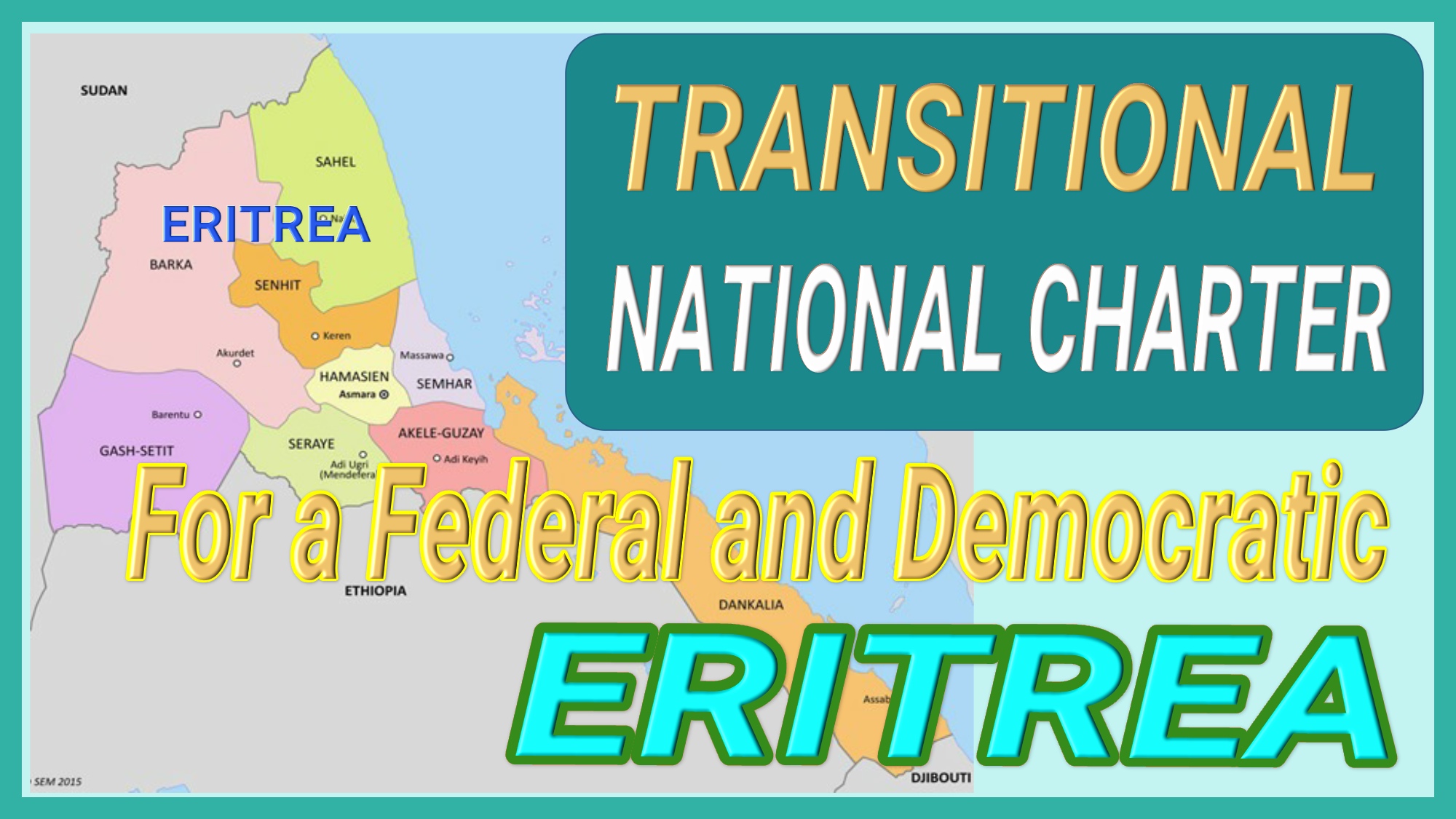
Transitional National Charter for a Federal and Democratic Eritrea,
by Dr. Negassi Hadgu.
PREAMBLE
We, the representatives of the Eritrean people, comprising delegates from political parties and movements, civil society organizations, regional caucuses, community elders, and independent patriots, assembled at the National Convention for a Democratic Eritrea:
Acknowledging the sacred sacrifices of generations who fought and died for a sovereign Eritrea founded upon freedom, liberty, justice, and dignity;
Condemning the betrayal of that liberation by the tyrannical PFDJ clique, led by the callous Isaias Afwerki, which for over three decades has subjected our people to systematic human rights violations, economic devastation, indefinite militarization, the unlawful mass incarceration of anyone suspected of intending to speak against its atrocities, and forced mass exile;
Recognizing that the hyper-centralized unitary state has been the principal instrument of oppression, enabling the concentration of absolute power in the hands of one man and his clique;
Affirming that lasting peace, stability, and prosperity require democratic governance, permanent decentralization, the rule of law, and the full protection of the rights of all citizens, regions, and communities;
Believing in the equality and dignity of all ethno-linguistic communities, the essential role of women and youth in leadership, and environmental stewardship for the well-being of future generations;
Determined to establish a transitional government that will, by all means necessary, eradicate the oppressive PFDJ regime of Isaias Afwerki, usher in an orderly transition, and lay the foundations for a federal, democratic Eritrea;
We do hereby adopt and pledge our allegiance to this Transitional National Charter as the supreme legal and moral framework governing the Eritrean Government-in-Exile (EGE), subject always to the will of the Eritrean people, and effective only until the ratification of a permanent democratic constitution by the free will of the Eritrean people.
VISION STATEMENT
To build a free, federal, and democratic Eritrea in which every citizen enjoys justice, liberty, equal opportunity, and the full measure of human rights, and in which power is permanently decentralized to prevent the return of tyranny.
ARTICLE 1: NAME AND STATUS
1.1 This document shall be known as the Transitional National Charter for a Federal and Democratic Eritrea (“the Charter”).
1.2 This Charter represents the framework proposed by organized opposition forces. Its legitimacy derives not from exile status but from its commitment to democratic process. The EGE pledges to validate its authority through rapid consultation with internal populations upon liberation and to defer to the democratically expressed will of all Eritreans in establishing permanent governance structures.
ARTICLE 2: FOUNDATIONAL PRINCIPLES
All members and organs of the EGE are irrevocably bound by the following principles:
2.1. Sovereignty of the People: All state power emanates from and resides with the Eritrean people. During the transition, the EGE shall act as a caretaker authority, exercising power through accountable institutions with the explicit and urgent mandate to return that power to the people through a free and fair constitutional and electoral process.
2.2. Universal Human Rights: The EGE shall uphold and defend all rights and freedoms enshrined in the Universal Declaration of Human Rights, including freedom of speech, press, assembly, association, belief, and conscience.
2.3. Rule of Law: All individuals, institutions, and organs of the EGE are equal before the law. No person or entity is above the law. Arbitrary detention, governance by decree, and extrajudicial punishment are strictly prohibited.
2.4. Secular and Inclusive State: Governance shall be independent of religious institutions. The state shall treat all ethno-linguistic communities, religions, and cultures with equal respect and shall not privilege any single identity over others.
2.5. Gender Equality: The EGE is fundamentally committed to the principle of full and equal participation of women in all levels of leadership, decision-making, and civic life. The EGE shall actively work to dismantle all barriers to women's participation and implement policies to progressively achieve gender parity in all institutions of governance.
2.6. Youth Inclusion: The EGE recognizes the critical role of youth (aged 18-39) in the liberation struggle and nation-building. The EGE shall actively promote meaningful youth participation in leadership positions across all Secretariats and ensure their voices are central to shaping Eritrea's democratic future.
2.7. Federal Democracy: Power shall be permanently decentralized through a system of geographical federalism based on Eritrea's nine historic Awrajas. This structure is the cornerstone of our democratic future and a non-negotiable commitment of this Charter.
2.8. Environmental Sustainability: The EGE recognizes that long-term prosperity depends on the sustainable management of natural resources, including water, forests, fisheries, mining and agricultural land, and commits to embedding environmental protection and ecological rebirth into all reconstruction and development planning, as detailed in this Charter.
ARTICLE 3: FEDERAL STRUCTURE AND DEMOCRATIC DETERMINATION
3.1. Federal System: Eritrea shall be a democratic federal state composed of nine regional states based on the historic Awrajas: Akele Guzay, Barka, Denkalia, Gash-Setit, Hamasien, Sahel, Semhar, Senhit, and Seraye.
3.2. Permanent Decentralization: Sovereignty shall be constitutionally divided between the federal and regional governments. Neither level may unilaterally abolish the powers of the other.
3.3. Entrenchment of Decentralization: The principle of decentralized governance and power-sharing is a foundational pillar of the new Eritrea and shall not be amended during the transitional period. Any future permanent constitution must include robust mechanisms for decentralization and the prevention of centralized authoritarian power.
3.4. Rationale and Guarantees: Geographical federalism ensures:
• Permanent prevention of one-man rule through structural decentralization.
• Protection of minority communities through equal regional representation.
• Local autonomy over education, infrastructure, resource management, and cultural policy.
• A check on central government overreach.
3.5. Working Framework: During the transitional period, the nine-Awraja federal system shall serve as the operational structure of the EGE, enabling effective coordination of the liberation struggle and demonstrating practical decentralized governance.
3.6. International Best Practice: The nine-Awraja federal model is grounded in comparative constitutional studies and represents the EGE's considered recommendation for Eritrea's permanent governmental structure, backed by research into successful federal systems worldwide.
3.7. Commitment to Democratic Determination:
While this Charter establishes the nine-Awraja federal system as the working framework and strong recommendation of the EGE, the final structure of the Eritrean state shall be determined by the Eritrean people through the Constitutional Convention (Article 11).
All participants in the EGE commit that:
1) Decentralization and power-sharing are non-negotiable principles that must be embedded in any permanent constitution to prevent the return of centralized tyranny;
2) The nine-Awraja federal model will receive comprehensive consideration and fair debate at the Constitutional Convention, with the EGE presenting its full case based on comparative research and Eritrea's specific needs;
3) Alternative models of decentralized governance that meet the non-negotiable requirement of preventing power concentration may also be presented and debated;
4) The people's democratically expressed will shall be sovereign in determining the final governmental structure;
5) Any permanent constitution must include:
a) Constitutional division of powers between national and regional levels
b) Mechanisms preventing unilateral centralization of authority
c) Protection of regional autonomy and minority rights
d) Checks and balances preventing executive overreach
6) This commitment ensures that:
a) The struggle against PFDJ dictatorship unites all democratic forces under the shared principle of decentralization;
b) The EGE operates effectively using the federal framework during the transition;
c) The Eritrean people retain ultimate authority to shape their governmental structure;
d) No future centralized dictatorship can emerge, regardless of the specific model chosen.
3.8. Territorial Integrity and Federal Unity:
1) Inviolable Unity: The unity and territorial integrity of Eritrea is inviolable. Unilateral secession by any Awraja or region is strictly prohibited and shall be considered a fundamental violation of this Charter.
2) Federalism as the Guarantee of Unity: The geographical federal system is adopted as the essential structure to preserve this unity. It is designed to prevent the internal conflicts that arise from centralized power, thereby ensuring a stable and cohesive nation where all regions have a permanent and secure stake in a unified Eritrea.
ARTICLE 4: MANDATE OF THE ERITREAN GOVERNMENT IN EXILE
The EGE is the sole legitimate transitional body representing the Eritrean democratic struggle. Its mandate is to:
4.1. Lead the unified national struggle to end the PFDJ dictatorship.
4.2. Serve as the official international representative of the Eritrean people.
4.3. Guarantee civilian supremacy over all aligned armed forces.
4.4. Manage the post-liberation transition until a democratically elected government is inaugurated.
4.5. Seek immediate and broad-based validation from the Eritrean population inside the country upon liberation to confirm its caretaker role.
ARTICLE 5: INSTITUTIONAL FRAMEWORK OF THE EGE
5.1. The Council Assembly (81 Seats) The supreme legislative and representative authority of the EGE, composed as follows:
• 27 Seats for Awraja Caucuses (3 representatives per Awraja)
• 27 Seats for credible political parties and movements committed to this Charter
• 18 Seats for civil society organizations (youth, women, professionals, human rights groups)
• 9 Seats for widely respected elders and community leaders
Powers: The Assembly approves all major policies, the budget, appointments of Secretaries, and amendments to this Charter.
5.2. The Federal Executive Council (FEC): Executive authority is vested in a 9-Member Federal Executive Council, with one member representing each of the nine Awrajas.
a) Selection: Each Awraja Caucus shall nominate one individual, who must be confirmed by a majority vote of the Council Assembly.
b) Rotating Coordinator: The role of Coordinator shall rotate annually among the members. The Coordinator is a facilitator and representative with no additional executive powers.
c) Decision-Making: Decisions require a simple majority (5 of 9) for routine matters and a super-majority (6 of 9) for critical decisions (e.g., military action, major financial allocations).
5.3. The Nine Secretariats: The administrative arms of the EGE, headed by Secretaries appointed by the FEC and confirmed by the Assembly. The Secretariats are:
1. Diplomacy and International Relations
2. Information and Public Outreach
3. Finance and Resource Mobilization
4. Constitutional Preparation
5. Transitional Justice
6. Economic Planning and Reconstruction
7. Secretariat for Defense: Responsible for overseeing all military operations under the absolute command of civilian leadership. This Secretariat shall establish and supervise the Central Military Command (CMC), the unified operational body coordinating all EGE-aligned armed units in accordance with this Charter and international humanitarian law. The CMC shall report exclusively to the Secretariat for Defense and, through it, to the Federal Executive Council, ensuring federal representation, strategic unity, and lawful conduct in all defense matters.
8. Interior and Homeland Security
9. Diaspora Affairs and Repatriation
5.4. Accountability Mechanisms
• Arbitration and Ethics Committee: An independent body of respected elders, legal experts, and human rights defenders responsible for mediating internal disputes, investigating alleged violations of the Charter, and recommending corrective actions to the Council Assembly.
• Preparatory and Vetting Committee: An impartial body of 7-9 politically neutral Eritreans responsible for establishing membership criteria, vetting applicants to the Council Assembly, organizing and presiding over the National Convention, and dissolving upon the election of the first Council Assembly.
5.5 Interim Regional Autonomy: During the transition, each Awraja shall be represented by an Interim Regional Council to manage local matters under the oversight of the Federal Executive Council.
ARTICLE 6: TRANSITIONAL JUSTICE COMMITMENTS
The Eritrean Government-in-Exile (EGE) recognizes that lasting peace and national unity require a comprehensive approach to transitional justice that addresses historical wrongs across multiple eras of conflict and oppression. The EGE commits to the following principles and actions to ensure accountability, truth-telling, healing, and guarantees of non-repetition for all periods of historical injustice.
6.1. Scope of Historical Contexts for Transitional Justice:
• Ethiopian Occupation Era (1958–1991): Acknowledges the widespread human rights violations committed by Ethiopian authorities.
• Intra-Eritrean Factional Abuses (1961–1991): Recognizes the atrocities committed by and between Eritrean liberation movements.
• PFDJ Dictatorship Abuses (1991–present): Condemns the systematic and ongoing crimes against humanity committed under the PFDJ regime.
6.2. Phased Implementation and Prioritization: To ensure an effective and manageable process, the Transitional Justice Secretariat shall implement its mandate in phases, prioritizing based on urgency, the need to preserve evidence, and the potential for immediate impact on national healing.
a) Phase One (Immediate Priority - 0-12 months post-liberation): PFDJ Dictatorship Abuses. Rationale: The recency and scale of these ongoing crimes require immediate action to secure evidence, dismantle the architecture of oppression, provide urgent support to victims, and hold high-level perpetrators accountable to prevent further harm.
b) Phase Two (Medium-Term Priority - 12-24 months post-liberation): Intra-Eritrean Factional Abuses. Rationale: Addressing these sensitive historical wounds is critical for national reconciliation and rebuilding trust between communities and political groups. This process will run concurrently with Phase One but requires careful groundwork, including community consultations and the establishment of restorative justice forums.
c) Phase Three (Long-Term Priority - 24+ months post-liberation): Ethiopian Occupation Era Abuses. Rationale: While crucial for the national narrative and justice for victims, this historical context involves complexities such as international cooperation and archival research that require a longer-term strategy. This phase will focus on documentation, memorialization, and seeking accountability through international channels.
6.3. Documentation and Prosecution:
a) Comprehensive Documentation: A dedicated effort shall be made to document abuses across all three historical contexts, guided by the prioritization outlined in Article 6.2.
b) Prosecution of Perpetrators: High-level perpetrators of crimes against humanity, war crimes, and gross human rights violations in each era shall be prosecuted under international and domestic law.
6.4. Truth and Reconciliation Commission (TRC): A national TRC shall be established within six months of liberation. It will have specific sub-committees addressing each historical context, with its public hearings and investigations sequenced according to the phased approach in Article 6.2.
6.5. Reparations for Victims: A Reparations Fund shall be established to provide material and symbolic reparations. Distribution will be phased, with initial focus on survivors of PFDJ atrocities, followed by victims of earlier eras.
6.6. Conditional Amnesty: Lower-level collaborators or participants in abuses across all historical contexts may receive conditional amnesty in exchange for full disclosure. High-level perpetrators from all eras shall be excluded from amnesty.
6.7. Non-Retribution for Reconciliation: To foster national reconciliation and prevent cycles of revenge, ordinary citizens, low-level civil servants, and conscripts who were coerced into supporting the regime shall not face discrimination or reprisal based on past affiliations. This policy does not apply to high-level PFDJ officials or individuals credibly accused of war crimes, crimes against humanity, or corruption.
6.8. Historical Narrative and Education: The EGE shall support the development of a comprehensive historical narrative to be integrated into educational curricula, ensuring future generations learn from all past injustices.
6.9. Community-Based Restorative Justice Forums: Localized restorative justice forums shall be established in each Awraja to address specific grievances, particularly related to intra-Eritrean factional abuses.
6.10. International Cooperation for Accountability: The EGE shall collaborate with international bodies to investigate and prosecute crimes, particularly where cross-border accountability (e.g., Ethiopian Occupation abuses) is required.
6.11. Guarantees of Non-Repetition: Structural reforms, including federal decentralization (Article 3) and civilian supremacy (Article 18), shall serve as guarantees against the recurrence of past abuses.
6.12. Vetting and Institutional Reform: A vetting process shall be implemented to prevent individuals complicit in gross human rights violations across all historical contexts from holding positions in the post-liberation government or security forces, guided by established international best practices.
ARTICLE 7: ECONOMIC AND DEVELOPMENT COMMITMENTS
7.1. Reconstruction Priorities: The EGE shall prioritize food security, employment creation, infrastructure rebuilding, and equitable resource distribution among all Awrajas.
7.2. Fiscal Federalism: A transparent system of revenue sharing between the federal government and Awraja governments shall be established to reduce regional disparities and empower local development.
7.3. Sovereignty Over Natural Resources: All natural resources are the collective sovereign property of the Eritrean people. Revenue shall be managed transparently and shared equitably between the federal government and the Awraja governments where resources are located.
7.4. International Partnerships: The EGE shall seek partnerships with international development organizations for technical and financial assistance, subject to sovereignty safeguards.
7.5. National Development Fund: A National Development Fund shall be established to promote vocational training and support civil society initiatives. This fund will address challenges such as public awareness, education, and economic stability, ensuring sustainable development and empowerment across all Awrajas.
7.6. Environmental Restoration and Management: In accordance with the foundational principle of Environmental Sovereignty and Sustainability (Article 2.8), the EGE commits to a national program for the long-term rebirth of nature, with special focus on Eritrea’s unique ecosystems. This program shall:
a) Combat Desertification and Land Degradation: Implement nationwide strategies to fight deforestation, reverse soil erosion, and halt desert expansion through reforestation, sustainable agriculture, and land reclamation projects.
b) Ensure Water Security: Prioritize water conservation through the construction and maintenance of dams, reservoirs, and water-catchment systems. Dam and reservoir water shall be strategically utilized for agricultural production, industry, and potable water access for communities.
c) Protect Biodiversity: Guarantee the comprehensive protection of all wildlife, from the smallest insects to the largest mammals, and all forms of indigenous plant life, from grasses and shrubs to large trees. This includes establishing and enforcing protected areas and anti-poaching laws.
d) Promote Research and Data Centralization: Mandate the systematic study of environmental and ecological conditions within each Awraja. The findings of all such studies shall be documented and made accessible through a central environmental database to guide policy and conservation efforts.
ARTICLE 8: IMMEDIATE SOCIAL SERVICES POST-LIBERATION
8.1. Priority Commitment: The EGE commits to restoring education and healthcare systems within the first 90 days of assuming transitional authority.
8.2. Education Initiatives: Reopen all schools, focusing on free primary and secondary education; establish a curriculum review committee to remove PFDJ propaganda, replacing it with civic education promoting democracy and human rights; initiate vocational training programs for youth.
8.3. Healthcare Initiatives: Provide emergency healthcare services free of charge, prioritizing maternal and child health; partner with international health organizations to address malnutrition and infectious diseases; develop a plan to rebuild hospitals and clinics.
8.4. Funding: These initiatives shall be funded through diaspora contributions, international aid, and recovered assets looted by the PFDJ regime.
ARTICLE 9: CITIZEN PARTICIPATION
9.1. Public Consultations: The EGE shall hold periodic public consultations, including diaspora assemblies, to ensure broad input into policy decisions.
9.2. Citizen Petition Mechanism: Any petition signed by at least 10,000 Eritreans from a minimum of four Awrajas must be formally debated by the Council Assembly within 60 days.
9.3. Transparency: All Council Assembly sessions, except those involving sensitive security matters, shall be open to public observation and their proceedings made available online.
9.4. Diaspora Rights: All persons of Eritrean descent have an inalienable right to Eritrean citizenship. The right to hold dual citizenship is guaranteed. All Eritrean citizens in the diaspora shall have the right to vote in national elections.
ARTICLE 10: MEMBERSHIP, ADHERENCE, AND ENFORCEMENT
10.1. Condition of Membership: Unequivocal acceptance of and adherence to every article of this Charter is a non-negotiable condition for membership in the EGE.
10.2. Public Declaration: All organizations and individuals joining the EGE must publicly sign this Charter, affirming their commitment to its principles.
10.3. Prohibition of Parallel Advocacy: Member organizations may not simultaneously participate in the EGE while externally advocating for positions contrary to this Charter, including support for a centralized unitary state.
10.4. Enforcement: Violations of the Charter will result in disciplinary action, including suspension or permanent expulsion from the EGE, as determined by the Arbitration and Ethics Committee and ratified by a two-thirds vote of the Council Assembly.
ARTICLE 11: POST-LIBERATION ROADMAP
Upon the collapse of the PFDJ regime (defined as loss of effective territorial control or authority), the EGE commits to the following binding timeline:
| Period After Liberation | Commitment |
|---|---|
| Within 90 Days | Convene regional and national consultations inside Eritrea to validate the EGE's role as Transitional Caretaker Government; repeal all repressive PFDJ laws; release all political prisoners unconditionally; secure key infrastructure |
| Within 6 Months | With its authority confirmed by the initial popular consultations, the EGE assumes full role of Transitional Caretaker Government. |
| Within 12 Months | Convene an inclusive National Constitutional Convention to draft the permanent federal constitution. |
| Within 18 Months | Organize and conduct free, fair, and multi-party national and regional elections under international observation. |
| Within 24 Months (Maximum) | Transfer all state power to the elected government; formally dissolve the EGE |
ARTICLE 12: LANGUAGE AND CULTURAL RIGHTS
12.1. Language Equality: The equality of all languages spoken by the Eritrean people is guaranteed.
12.2. Regional Autonomy: Each Awraja government shall conduct official business in the language(s) predominantly spoken in that region.
12.3. Right to Services: Citizens have the right to receive government services, education, and judicial proceedings in their native language where practicable.
12.4. Federal Support: The federal government shall provide translation and interpretation services to ensure no citizen is disadvantaged due to language barriers.
ARTICLE 13: LIMITATION ON EMERGENCY POWERS
13.1. Grounds for Declaration: The EGE may declare a state of emergency only in cases of imminent foreign invasion, natural disaster of catastrophic scale, or armed insurrection threatening the territorial integrity of the state.
13.2. Approval Process: Any declaration of emergency must be approved by a 6/9 super-majority of the Federal Executive Council AND ratified by a 2/3 majority of the Council Assembly within 72 hours.
13.3. Duration: A state of emergency shall last no more than 90 days and may be renewed only once, with the same procedural requirements.
13.4. Inviolable Rights: During any state of emergency, the following rights shall remain inviolable: prohibition of torture, right to life, freedom of religion, and the right to legal representation.
13.5. Oversight: The Arbitration and Ethics Committee shall have the authority to review any emergency measure and recommend its immediate revocation if it violates this Charter.
ARTICLE 14: TRANSPARENCY AND ANTI-CORRUPTION MEASURES
14.1. Public Ledger: All EGE financial transactions, including donations, expenditures, and contracts, shall be recorded in a public ledger accessible online to all Eritreans.
14.2. Independent Audits: An independent auditing firm shall conduct quarterly financial audits of the EGE, with reports published publicly.
14.3. Penalties for Corruption: Any EGE member found guilty of corruption shall be immediately removed from office, barred from holding any public position in the post-liberation government, and required to repay all misappropriated funds.
14.4. Whistleblower Protection: A mechanism shall be established to encourage reporting of corruption without fear of retaliation, including anonymity protections and legal defense support.
ARTICLE 15: FREEDOM OF PRESS AND ACCESS TO INFORMATION
15.1. Press Freedom: The EGE shall guarantee the freedom of the press and protect independent media from censorship, harassment, or undue interference.
15.2. Public Access to Information: The EGE commits to publishing all non-classified government decisions, budgets, and reports within 30 days of their adoption.
ARTICLE 16: GENDER EQUALITY AND VULNERABLE GROUPS
16.1. Gender Equality: The EGE is fundamentally committed to the principle of full and equal participation of women in all levels of leadership, decision-making, and civic life. The EGE shall actively work to dismantle all barriers to women's participation and implement policies to progressively achieve gender parity in all institutions of governance.
16.2. Legal Protections: The permanent constitution shall include provisions prohibiting all forms of gender-based violence and discrimination.
16.4. Support for Vulnerable Groups: Specific protections and support programs shall be established for survivors of sexual violence, child soldiers and youth conscripted under the PFDJ regime, persons with disabilities, and internally displaced persons and returnees.
ARTICLE 17: REPATRIATION AND REFUGEE RIGHTS
17.1. Voluntary Repatriation and Return: The EGE commits to facilitating the voluntary, safe, and dignified return of all Eritrean refugees and internally displaced persons. This commitment is comprehensive and encompasses all individuals displaced throughout Eritrea's modern history, including the period of Ethiopian annexation, the war for independence, and the post-1991 era.
17.2. Property Rights: Returnees shall have the right to reclaim property confiscated by the PFDJ regime and other actors or receive fair compensation if reclamation is not possible.
17.3. International Cooperation: The EGE shall work with organizations such as the UNHCR to establish repatriation programs, provide temporary housing, and ensure access to education and healthcare for returnees.
17.4. Non-Discrimination: No returnee shall face discrimination or reprisal based on their status as a former refugee or their political activities while in exile.
17.5. Reintegration Fund: A dedicated fund, managed by the Secretariat for Diaspora Affairs and Repatriation, shall be established to support reintegration efforts.
RTICLE 18: CIVILIAN SUPREMACY AND THE CENTRAL MILITARY COMMAND (CMC)
18.1 Civilian Control: All armed forces shall be under the absolute command of the EGE's civilian Federal Executive Council through the Secretariat for Defense. No armed group may maintain an independent command structure.
18.2 Establishment of the Central Military Command (CMC): The CMC is the supreme coordinating body for all EGE-aligned armed forces, tasked with unifying military operations to liberate Eritrea and secure the democratic transition.
• Composition: Nine Senior Command Officers, one nominated by each Awraja Caucus and confirmed by the Council Assembly. Officers must demonstrate military competence, a clean human rights record, and loyalty to federal democracy.
• Chain of Command: The CMC reports directly and exclusively to the Secretariat for Defense, which in turn is accountable to the FEC. The CMC executes directives; it does not formulate political or strategic policy.
• Leadership: The CMC shall elect a Joint Chief of Staff for a non-renewable two-year term, executing strategy strictly within directives set by the Secretariat for Defense and approved by the Federal Executive Council.
18.3. Rules of Engagement: The CMC and all subordinate units must strictly adhere to international humanitarian law. Violations will be subject to investigation and prosecution.
18.4. Post-Liberation: The CMC will serve as the foundation for creating a single, professional, and apolitical National Defense Force under the permanent constitution. A comprehensive Disarmament, Demobilization, and Reintegration (DDR) program will be initiated.
ARTICLE 19: INTERNATIONAL COOPERATION PRINCIPLES
19.1. Partnerships: The EGE may enter into partnerships with foreign governments, international organizations, and non-governmental entities to advance the liberation struggle and prepare for reconstruction.
19.2. Safeguards on Sovereignty: No agreement with a foreign entity shall compromise Eritrea's sovereignty or territorial integrity, grant exclusive economic concessions without public disclosure and Assembly approval, commit Eritrea to military alliances or foreign military bases, or contradict the principles of this Charter.
19.3. Transparency: All international agreements must be approved by a 2/3 majority of the Council Assembly and published publicly within 30 days of signing.
19.4. Non-Interference: The EGE shall maintain a policy of non-interference in the internal affairs of other nations and shall not allow Eritrean territory to be used to destabilize neighboring countries.
ARTICLE 20: INTERNATIONAL OBSERVATION
20.1. Observation Mandate: The EGE shall invite independent international observers from the United Nations, African Union, and credible non-governmental organizations to monitor and report on the National Constitutional Convention process and the conduct of national and regional elections.
20.2. Public Reporting: Reports from international observers shall be made public within 30 days of completion to ensure transparency and build confidence in the transitional process.
20.3. Technical Assistance: The EGE may request technical assistance from international partners for election logistics, voter registration, and constitutional drafting, provided such assistance does not compromise Eritrea's sovereignty or the principles of this Charter.
ARTICLE 21: CONTINGENCY FOR SUDDEN REGIME COLLAPSE
21.1. Interim Authority: If the PFDJ regime collapses before the full establishment of the EGE, the existing Preparatory and Vetting Committee shall immediately convene an emergency session within 7 days, form an Interim Executive Council composed of representatives from participating organizations, issue a public declaration assuming transitional authority, and accelerate the timeline for convening the National Convention to within 30 days.
21.2. Limited Powers: Any Interim Executive Council formed under this article shall have authority only to maintain public order, prevent humanitarian catastrophe, prevent looting of state assets, and facilitate the rapid establishment of the full EGE structure.
21.3. Restrictions: The Interim Executive Council shall have no authority to amend this Charter, negotiate international treaties, or make decisions binding on the permanent government.
ARTICLE 22: PERIODIC REVIEW DURING TRANSITION
22.1. Biannual Review: The EGE shall conduct a biannual review of the implementation of this Charter to assess progress, identify obstacles, and recommend temporary operational adjustments if necessary.
22.2. Review Process: Reviews shall be conducted by a joint committee comprising members of the Arbitration and Ethics Committee and representatives from each Awraja Caucus.
22.3. Approval of Adjustments: Any proposed adjustments must be approved by a 3/4 majority of the Council Assembly and may not alter the Foundational Principles (Article 2) or the Federal Structure (Article 3).
22.4. Public Reporting: All review findings and recommendations shall be published publicly within 30 days of completion.
ARTICLE 23: SUPREMACY OF THE CHARTER
23.1. Supreme Law: This Charter is the supreme law of the Eritrean Government in Exile during the transitional period.
23.2. Binding Authority: All decisions, proclamations, and actions by any organ of the EGE must conform to the principles and procedures established in this Charter.
23.3. Nullification of Violations: Any decision or action found by the Arbitration and Ethics Committee to violate this Charter shall be null and void.
23.4. No Exceptions: No organ of the EGE may cite operational necessity, political expediency, or external pressure as justification for violating the Charter.
ARTICLE 24: RATIFICATION AND AMENDMENT
24.1. Ratification: This Charter shall enter into force upon ratification by a two-thirds (2/3) majority vote of all delegates at the National Convention for a Democratic Eritrea, including concurrent majority approval from at least seven of the nine Awraja Caucus delegations.
24.2. Amendment: This Charter may only be amended by a three-quarters (3/4) majority vote of the full Council Assembly, including concurrent majority support from at least seven of the nine Awraja Caucuses.
2.3. Entrenched Articles: Articles 2 (Foundational Principles) and 3 (Federal Structure) are fundamental and not subject to amendment during the transitional period.
SIGNATORIES
We, the undersigned, on behalf of the organizations and communities we represent, pledge our honor and commitment to uphold this Charter for the liberation, unity, and prosperity of the Eritrean people.
Representatives of Political Parties and Movements
Representatives of Civil Society Organizations:
1) For the youth
2) For the women
3) For the professionals
4) For the human rights groups
Representatives of Awraja Caucuses
Elders and Community Leaders
Victory and glory to the Eritrean people!
God Bless Eritrea and its people!
A fellow Eritrean committed to freedom, liberty and justice for all,
Dr. Negassi Hadgu,
November 25, 2025
Read in PDF ብ'PDF ንምንባብ ኣብዚ ጠውቑ።
See also more articles by Dr. Negassi Hadgu
ካልኦት ብ'ዶር ነጋሲ ሓድጉ ዝተጻሕፉ ጽሑፋት ኣብ ታሕቲ ተወከሱ:-
Snitna Network Seminar: On Saturday, 19 July 2025.
Topic:
The constitutional models.
መንግስታዊ ስርዓታት
النموذج الدستوري
Panellists on Thematic Topics ተዛተይቲ:-
Decentralized model: Panelist: Judge Habteab Yemane
Federal model: Panelist: Dr Mohammed Kheir Omer
Unitary model: Panelist: Prof Kidane Mengsteab
Moderator: Dr Mebrahtu Ateweberhan
Part-1 of 4:
Part-2 of 4:
Part-3 of 4:
Part-4 of 4:
 ብተወሳኺ፡ ነቲ ኣብ ዩቱብ ቻነል ዝወጽእ ሓበሬታ፡ ንመትከላት ማሕበራዊ መትከላት ዩቱብ (YouTube Community Guidelines)፡ እናኽበረ የውጽእ። ስኒትና፡ ብዝከኣሎ መጠን፡ ነዚ መትከላት'ዚን ናይ ሃገርና ኤርትራን ህዝባን ክዉንነትን ምርኩስ ገይሩ፡ ኣብ መርበብ ሓበሬታኡ ስኒትና (www.snitna.com) ክውጽእ ዝግብኦ ሓበሬታ እናመመየ ከውጽእ ይህቅንን ይጽዕርን። እዚ ስራሕዚ ምሉእ ዓወት ንክህልዎ ድማ ብዓቢኡ፡ ግቡእ ኣጠቓቕማ ተሳተፍቲን ምትሕብባርን ምስዝህሉ ኢዩ። ስለዚ፡ ነዚ መትከላት ዚ ንምኽባር ንኹሉ ተገልጋላይ'ዚ መርበብዚ ንጽውዕ። ዝኾነ ሃሳዪ ተርእዮታት ምስዘጋጥሙ፡ ቅሬታኹም ወይ ርእይቶኹም ብኢመይል ኣድራሻና ኣቢልኩም ክትልእኩልና ንላቦ።
 See also Related / ምስዚ ዝተኣሳሰር ሓበሬታ፡-
- Snitna YouTube - ስኒትና ዩቱብ ቻነል።
- Snitna Network and Sinit Seminars Directory. ብ`ስኒትና ከምኡ`ውን ስኒት ዝተኻየዱ ሰሚናራት።
- Snitna FaceBook - ስኒትና ፌስቡክ።
- Sinit YouTube - ስኒት ዩቱብ ቻነል።
- ዘተ ንሓባራዊ ንቕሓት
Dialogue for Common Awareness
مجموعة الحوار للوعي المشترك - ሌላ ምስ
ፖለቲካዊ ሰልፍታትን ህዝባዊ ምንቅስቓሳትን ኤርትራ፡
Eritrean Political parties and Civic movements.s
مقدمة في الأحزاب السياسية والحركات المدنية الإريترية - BUILDING DEMOCRACY IN ERITREA - ህንጸት ዲሞክራሲ ኣብ ኤርትራ بناء الديمقراطية في إريتريا
- ሕግን ሕብረተሰብን - Law and Society.
- ኣስተምህሮ፡ መስርሕ ምንዳፍ ቅዋም ኤርትራ - The Eritrean Constitution Making Process
Seminar by Dr Bereket Habte selassie. ኣስተምህሮ፡ ብ`ዶር. በረኸት ሃብተስላሰ። - ሲምፖዝዩም ኤርትራ (Eri-Platform: 2018 - 2020)
- ዋዕላ ህንጸት ዲሞክራሲ ኣብ ኤርትራ Building Democracy in Eritrea Conference (Eritrea Focus: 2019 - 2020)
- Enough is enough! ይኣክል ምልኪ! ማዕበል ድምጺ ህዝቢ لقد طفح الكيل
- 1993, Eritrean independence referendum Results
ታሪኻዊ ውጽኢት ረፈረንዱም ኤርትራ 1993. - ሃገራዊ ቻርተር ኤርትራ - ኣብ 3ይ ጉባኤ ህ.ግ.ሓ.ኤ: ዝጸደቐ (ናቕፋ 10 - 16 ለካቲት 1994)።
- PFDJ NATIONAL CHARTER Adopted by the 3rd Congress of the EPLF/PFDJ Naqfa, February 10-16, 1994.
- ንዝኽሪ ግዳያት ዲክታቶሪያዊ ምሕደራ ኤርትራ። In memory of Victims of Dictatorial Administration in Eritrea.
- G-15:- ቅልዕቲ ወረቐት ናብ ህዝቢ ኤርትራ፡ ኣገደስቲ እዋናውያን ጉዳያት፡ (ኣስመራ፡ ነሓሰ 3፡ 2001)
- G-15:-Open Letter To The People of Eritrea (Asmara, August 3, 2001)
- G-15:-ቅሉዕ መልእኽቲ ናብ ኩሎም ኣባላት ህግደፍ
- G-15:-Open Letter to All PFDJ Members (Audio) ቅሉዕ መልእኽቲ ናብ ኩሎም ኣባላት ህግደፍ (ብድምጺ)
- G-15:-Open Letter to All PFDJ Members
- GI: ህጹጽ ጻውዒት ንኹሎም ኣብ መላእ ኵርናዓት ዓለም ዝርከቡ ኤርትራውያን። An Urgent Call to All Eritreans Worldwide. المبادرة العالمية لتمكين الحركة الشعبية الاريترية
- ድምጽና (Our Voice)
- መደብ ንጋባእ ENGAGE ERITREA!
- Advice for All Eritreans ምኽሪ ንኹሎም ኤርትራውያን
- UN Human Rights Council - Human Rights in Eritrea (Website) / ናይ ውሕሃ ቤትምኽሪ ሰብኣዊ መሰላት - ኩነታት ሰብኣዊ መሰላት ኣብ ኤርትራ፡ (Website)
- UN Human Rights Council - Human Rights in Eritrea (YouTube) / ናይ ውሕሃ ቤትምኽሪ ሰብኣዊ መሰላት - ኩነታት ሰብኣዊ መሰላት ኣብ ኤርትራ፡ (YouTube)
- Human Rights in Eritrea / ኩነታት ሰብኣዊ መሰላት ኣብ ኤርትራ፡
- UN - Commission of inquiry on Eritrea / ናይ ውሕሃ መርማሪት ኮሚሽን ሰብኣዊ መሰላት ኤርትራ፡
- Mike Smith / ሚስተር ማይክ ስሚዝ፡ ኣቦ ወንበር መርማሪት ኮሚሽን ሰብኣዊ መሰላት ኤርትራ፡
- Also see: "UN - COI on Eritrea / ናይ ውሕሃ መርማሪት ኮሚሽን ሰብኣዊ መሰላት ኤርትራ፡
- UN COMMISSION OF INQUIRY ERITREA (COI-ERITREA) And POPULAR RESPONSES
- ጸብጻብ መርማሪት ኮሚሽን ሰብኣዊ መሰላት ኤርትራ፡ ህዝባዊ ግብረ-መልሲን
- ጸብጻብ መርማሪት ኮምሽን ኵነታት ሰብኣዊ መሰላት ኣብ ኤርትራ – ዘይወግዓዊ ትርጉም (ብትግርኛ)