

13/08/2026 18:48 PM
SHIELDING THE ERITREAN STRUGGLE FOR FREEDOM AND LIBERTY
from the Expansionist Ethiopian Regime, Petrodollar-Funded Arab Monarchs and More
By Dr. Negassi Hadgu
Introduction: A Nation Under Siege from Within and Without
The Eritrean people are currently fighting an existential war of survival on multiple fronts simultaneously. Inside our borders, we endure the suffocating grip of the PFDJ regime. This authoritarian system has transformed our beloved nation into an open-air prison. The regime is systematically executing a silent genocide against our youth, draining the lifeblood of our nation through forced conscription, arbitrary imprisonment, and the deliberate destruction of all civic life. Our brightest sons and daughters are fleeing across deserts and seas, perishing in the Sahara and drowning in the Mediterranean, choosing death over the slow suffocation of life under PFDJ tyranny.
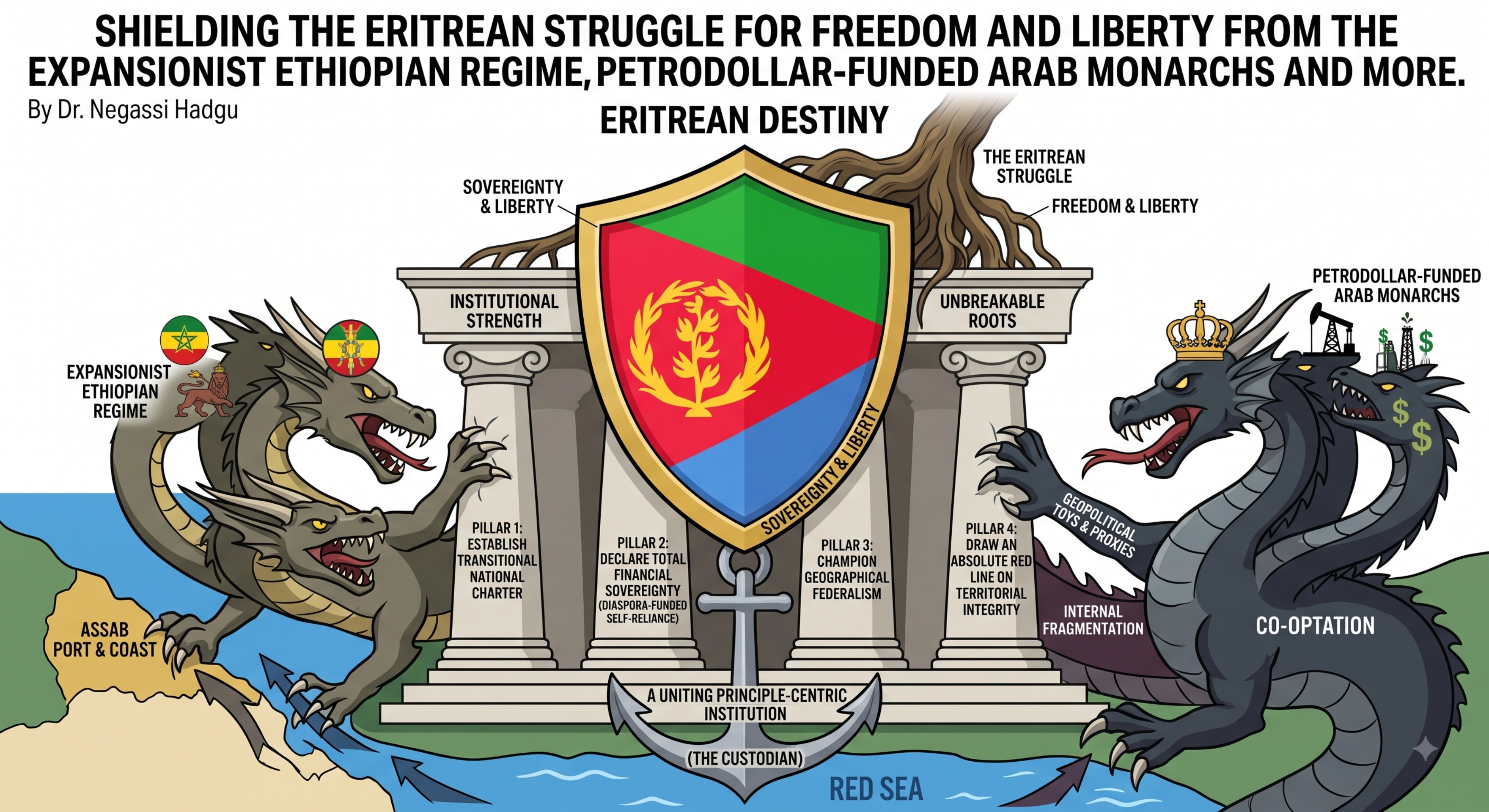
But as we fight to dismantle this internal tyranny, a second and equally perilous front has emerged beyond our borders. Our sacred struggle for liberty and democracy is in grave danger of being hijacked by forces that do not wish us well. In the absence of a unified, institutionalized leadership and a legitimate custodian of the people's will, the Eritrean democratic resistance is increasingly being treated as a geopolitical toy. We find ourselves squeezed between two powerful and predatory external forces. On one side stands the expansionist, genocidal regime of Ethiopian Prime Minister Abiy Ahmed. On the other side stand the petrodollar-funded Arab monarchs of the Gulf. Both forces seek to exploit our national tragedy to advance their own strategic supremacy over the Horn of Africa and the precious waters of the Red Sea.
As I recently noted in Dinner for Bullets, authoritarian regimes across our region, from Eritrea to Sudan to Ethiopia, are actively turning their most vulnerable citizens into proxies and pawns. They trade human lives for political survival. If we do not urgently and deliberately course-correct, we risk overthrowing a domestic dictator only to surrender our hard-won sovereignty to foreign masters. The question that confronts every Eritrean patriot, every defender of our dignity, and every believer in our national future is urgent and unavoidable. How do we shield our struggle and reclaim our agency? How do we ensure that the blood of our martyrs is not cheapened by the geopolitical calculations of foreign powers?
Part I: Understanding Our Vulnerability
Before we can prescribe a cure, we must honestly diagnose the disease. The foundational vulnerability of the Eritrean resistance today is its structural fragmentation. Foreign powers do not respect a divided movement. They exploit it.
Because the Eritrean opposition currently lacks a centralized, representative body to act as the legitimate custodian of the people's collective will, external actors see a dangerous power vacuum that they are rushing to fill with their own handpicked proxies. When a movement is fractured into rival political factions, competing civic organizations, and regional silos that refuse to coordinate, it becomes dangerously dependent on external patronage for its survival. This dependency is not benign. It is the very mechanism through which foreign powers purchase the loyalty of individual factions and ultimately redirect the entire movement toward their own geopolitical goals rather than the genuine liberation of the Eritrean people.
History teaches us a painful lesson that we must internalize. No liberation movement that relied primarily on foreign patronage ever delivered genuine freedom to its people. Foreign sponsors do not fund revolutions out of altruism. They fund proxies. And proxies do not serve the people. They serve their sponsors.
The Eritrean opposition has experienced this tragedy before. The Eritrean Democratic Alliance and the Eritrean National Council for Democratic Change both collapsed not because Eritreans lacked the will to unite, but because those coalitions were tactical compromises between political elites rather than genuine, institutionally grounded fronts built on shared and binding principles. Without a constitutional anchor, every coalition eventually dissolves under the weight of competing personal ambitions and competing foreign sponsors. We cannot afford to repeat this cycle. The cost of continued fragmentation is measured not in political setbacks but in human lives.
Nowhere is this vulnerability more tragically visible today than in the fragmentation of our youth movements. The Eritrean youth in the diaspora represent the beating pulse of our resistance. Movements like Brigade N'Hamedu have demonstrated breathtaking courage, shattering the myth of PFDJ invincibility and dismantling the regime's transnational extortion networks across the globe. They have shown that the diaspora will no longer tolerate the regime's festivals of oppression.
Yet, courage without structure is a fire that eventually consumes itself. We are currently witnessing a heartbreaking fracturing within the very vanguard of our struggle. The organic energy of the youth has splintered into competing camps, with deep divisions emerging between factions of Brigade N'Hamedu, various Global diaspora initiatives, and the Eritrean Blue Revolution Front. Instead of pooling their massive potential into a single, unstoppable tidal wave of democratic change, these groups are increasingly trapped in cycles of internal friction, leadership disputes, and organizational rivalries.
This fragmentation is not just a strategic error. It is a direct invitation for infiltration. When the youth are divided into competing factions, they become prime targets for external manipulation. Expansionist intelligence agencies in Addis Ababa and petrodollar networks in the Gulf are constantly searching for energetic, aggrieved, and disorganized youth movements to co-opt. They seek to turn these factions against one another, weaponizing their righteous anger to serve foreign geopolitical agendas.
Part II: The Twin Threats to Our Struggle
The Expansionist Threat from Addis Ababa
The most immediate and openly declared external threat to the Eritrean democratic struggle today comes from the regime currently ruling Ethiopia. Facing catastrophic internal crises, including the devastating Tigray war, rampant ethnic violence across Oromia and Amhara, and a deepening economic collapse, Prime Minister Abiy Ahmed has chosen the oldest tool of desperate rulers. He has manufactured an external enemy and cultivated the dream of territorial expansion to distract his population from his regime's failures.
His regime has engaged in open and shameless historical revisionism, publicly declaring that Ethiopia has an existential right to the Eritrean Red Sea coast and the sovereign port of Assab. Senior Ethiopian military officials have echoed this dangerous rhetoric, framing access to Eritrean territory not as a matter of diplomacy and mutual benefit but as a biological necessity for the Ethiopian state. This is not the language of a peaceful neighbor seeking cooperation. This is the language of a predator seeking prey.
To achieve its territorial ambitions without triggering immediate international condemnation, the Ethiopian regime has adopted a subtler and more insidious strategy alongside its military posturing. It seeks to infiltrate and co-opt vulnerable factions within the Eritrean opposition. It attempts to export the catastrophically failed model of ethnic federalism into Eritrea, the very same model that has already torn Ethiopia itself apart with devastating consequences. By trying to weaponize the legitimate political grievances of historically marginalized Eritrean communities, the Addis Ababa regime hopes to ignite internal ethnic conflict within Eritrea. The ultimate goal is to use those fractures as a justification for intervention, occupation, and the eventual annexation of the Eritrean coast under the guise of protecting minority rights and proxy alliances.
We saw the clearest and most alarming expression of this strategy at the 3rd Congress of the Eritrean Afar National Congress in 2026, where foreign-aligned academics openly called for Ethiopian military occupation of Asmara and the imposition of an Ethiopian-style constitution on the Eritrean people. Such calls must be recognized for precisely what they are. They are intellectual cover for colonial aggression, dressed in the seductive language of liberation, indigenous rights, and democratic reform.
Eritrea's borders are not a historical accident. They are the product of over one hundred years of international treaties, colonial administrative boundaries, thirty years of liberation war, and the binding 2002 Eritrea-Ethiopia Boundary Commission ruling that Ethiopia itself accepted. No amount of historical revisionism, academic advocacy, or military posturing can erase these legal and historical realities.
The Petrodollar Proxy Trap
On the other flank, the wealthy Arab monarchies of the Gulf view the Red Sea corridor as their personal geopolitical chessboard. The Red Sea is the artery through which approximately twelve percent of global trade flows. It connects the Gulf of Aden to the Suez Canal and is of supreme strategic value to Gulf states whose economies and security calculations depend on the uninterrupted flow of exports and the containment of rival regional powers.
For these monarchs, the Eritrean coast is not the homeland of a proud and suffering people with a rich and ancient history. It is a strategic real estate asset. By funneling petrodollars to select Eritrean political factions, financing particular opposition figures, and subtly shaping the discourse within the diaspora community, these states are not investing in Eritrean democracy. They are purchasing compliant proxies who will, when the time comes, advance Gulf maritime interests over Eritrean national ones.
A resistance movement that is dependent on the intelligence budgets and royal endowments of foreign capitals inevitably becomes a tool for foreign agendas. The principle is simple and brutally honest. He who pays the piper calls the tune. And the tune being composed in Riyadh, Abu Dhabi, and Doha is designed to secure Arab maritime dominance and Gulf strategic depth, not Eritrean freedom, self-determination, and constitutional democracy.
Part III: The Blueprint for a Sovereign and Shielded Resistance
To stop being the plaything of expansionists and monarchs, the Eritrean resistance must immediately and decisively transform its structural weaknesses into institutional strength. As I argued in Building Tomorrow's Democratic Eritrea Today, we cannot wait for the collapse of the regime to begin designing its replacement. The architecture of a democratic state must be built now, in the diaspora and the underground, so that no vacuum exists when tyranny falls. Here is the roadmap to shield our struggle and reclaim our destiny.
First Pillar: Establish a Transitional National Charter
The Eritrean opposition must immediately convene a broad, inclusive national congress to adopt a Transitional National Charter that establishes a united, institutional body. This Charter must be the supreme governing document of our united resistance. It must enshrine our non-negotiable core principles, including the absolute defense of Eritrean sovereignty and territorial integrity, the establishment of a constitutional and democratic state, the protection of the rights of all Eritrean communities, and the explicit rejection of any foreign military intervention as a tool for political change in Eritrea.
This Charter will serve as the true, institutional custodian of our struggle. It replaces the dangerous vulnerability of a leader-centric movement, which foreign powers can neutralize by eliminating or co-opting a single individual, with the indestructible strength of a principle-centric institution. When regional vultures and foreign monarchs study the Eritrean opposition, they must face an impenetrable fortress of unified democratic principles rather than a buffet of rival factions they can easily buy off, manipulate, or play against one another.
Second Pillar: Declare Total Financial Sovereignty
This point cannot be overstated. We cannot fight for the political independence of our nation while using the currency of foreign capitals to fund that fight. Financial dependence is not a neutral administrative inconvenience. It is the most direct and most effective form of political subjection. Every riyal, every dirham, and every dollar that flows from a foreign monarch's treasury into an Eritrean opposition budget comes with invisible strings attached.
We must transition immediately and completely to a fully self-reliant funding model. This means establishing transparent, auditable, and grassroots crowdfunding mechanisms that are accountable to the Eritrean people and governed by the united body's charter. A movement that funds itself from the contributions of its own people answers only to those people. It cannot be bought. It cannot be redirected. It cannot be silenced by the strategic withdrawal of foreign patronage.
Third Pillar: Champion Geographical Federalism as the Democratic Alternative
One of the most powerful and most dangerous tools in the arsenal of expansionist powers is the strategy of divide and conquer through the manufactured and cynical politicization of ethnic identity. The Ethiopian regime, in particular, has shown a deep and persistent appetite for exporting the model of ethnic federalism into Eritrea.
The genuine antidote to this poison is to offer a demonstrably just, democratic, and workable alternative that addresses the grievances of historically marginalized communities comprehensively and permanently, without fracturing the unity of the nation. That alternative is Geographical Federalism. Under this model, political and administrative power is decentralized and devolved to regional and local governments based on geographic and population criteria rather than ethnic identity. Every region of Eritrea would have genuine self-governance, equitable resource allocation, a constitutionally guaranteed share of revenues derived from resources within its territory, and the full protection of its cultural and linguistic heritage. By offering all communities genuine justice within a united republic, we remove the very grievances that foreign powers depend upon to justify their interference in our internal affairs.
Fourth Pillar: Draw an Absolute Red Line on Sovereignty
Our diplomatic messaging must be crystal clear and completely unified. The Eritrean democratic movement is not simply an anti-PFDJ coalition focused solely on domestic governance. It is the ultimate defender of Eritrean sovereignty and territorial integrity against both internal tyranny and external aggression.
Eritrea's borders are not a matter of negotiation or creative reinterpretation. They are sealed by history, by international law, by the foundational principle of uti possidetis juris, by the 1993 United Nations supervised independence referendum, and by the binding 2002 Eritrea-Ethiopia Boundary Commission ruling. Every drop of blood shed by our martyrs during thirty years of liberation struggle was shed in defense of those borders and that sovereignty. To entertain any compromise on our territorial integrity is to desecrate the memory of those martyrs and to betray the trust of every living Eritrean.
Any opposition figure, organization, or platform that flirts with Ethiopian expansionism, entertains the leasing away of our sovereignty over the Red Sea, acts as an intellectual apologist for foreign occupation, or functions as a mouthpiece for foreign intelligence agencies must be clearly and permanently excommunicated from the democratic bloc. Sovereignty is not a bargaining chip to be traded for foreign support. It is the foundation upon which everything else rests.
Part IV: A Call for an Immediate National Democratic Convention
The analysis presented in this article leads to one unavoidable conclusion. The time for debate alone has passed. The time for action has arrived.
I call on every Eritrean democratic political organization, every civic association, every traditional and community leader, every constitutional scholar, every women's group, every youth movement, and every diaspora community around the world to immediately begin preparations for a National Democratic Convention. The purpose of this Convention is not to declare a winner among competing political factions. It is to adopt a Transitional National Charter, establish a united institutional body, and present the world with a single, legitimate, democratic voice of the Eritrean people.
This Convention must be structured around the nine historic Awrajas, ensuring that every region of Eritrea has equal dignity and equal representation at the founding table of our democratic future. It must operate transparently and be funded exclusively by the Eritrean diaspora. And it must produce a Charter that is built not on the personalities of its founders but on the enduring principles of sovereignty, democracy, geographical federalism, and human dignity.
Conclusion: Our Destiny, Written by Our Own Hands
The absence of a single, centralized leader is not a sentence of permanent weakness. It is an opportunity to build a resilient, democratic institution that is stronger than any individual and more durable than any personal leadership. Institutions endure. Individuals can be co-opted, imprisoned, exiled, or killed. A united body governed by a shared charter, funded by its own people, and anchored in non-negotiable principles of sovereignty and democracy is the most powerful and the most durable instrument of liberation we can build.
If we unite under a Transitional National Charter, achieve genuine financial sovereignty through diaspora-funded self-reliance, offer every Eritrean community a just and permanent constitutional home through Geographical Federalism, and stand as one immovable, principled wall in defense of our territorial integrity, we become untouchable. We transform ourselves from a collection of grievances into a credible governing alternative. We transform the Eritrean democratic struggle from a geopolitical toy into a sovereign and unstoppable national movement.
The future of a free, democratic, and dignified Eritrea will not be written in Addis Ababa. It will not be written in Riyadh, Abu Dhabi, or Doha. It will not be written in any foreign capital by any foreign hand, however well-funded or well-intentioned that hand may claim to be. It will be written by Eritreans, for Eritreans, on Eritrean soil, under an Eritrean sky, and on Eritrean terms alone.
That is not merely a dream. That is our destiny, and it is time we had the courage and the unity to claim it.
Victory and Glory to the Eritrean People.
God Bless Eritrea and All Her People.
Negassi Hadgu
August 10, 2026
References
1. Hadgu, N. "Beyond Tyranny: A Case for Geographical Federalism in a Post-PFDJ Eritrea." Snitna.com.
https://snitna.com/articles/beyond-tyranny-a-case-for-geographical-federalism-in-a-post-pfdj-eritrea.php
2. Hadgu, N. "Building Tomorrow's Democratic Eritrea Today." Snitna.com.
https://snitna.com/articles/building-tomorrows-democratic-eritrea-today.php
3. Hadgu, N. "Dinner for Bullets: How Authoritarian Regimes in Eritrea, Sudan, and Ethiopia are Turning Their Citizens into Proxies and Pawns." Snitna.com.
https://snitna.com/articles/dinner-for-bullets-how-authoritarian-regimes-in-eritrea-sudan-and-ethiopia-are-turning-their-citizens-into-proxies-and-pawns.php
4. Hadgu, N. "Sovereignty Is Not Negotiable: Rebutting Professor Joseph Eliot Magnet's Call for Ethiopian Occupation." Snitna.com.
https://snitna.com/articles/sovereignty-is-not-negotiable-rebutting-professor-joseph-eliot-magnet-s-call-for-ethiopian-occupation-by-dr-negassi-hadgu.php
5. Hadgu, N. "Sovereignty is Not Up for Debate: Debunking Ethiopia's Historical Revisionism Over the Red Sea and Assab." Snitna.com.
https://snitna.com/articles/sovereignty-is-not-up-for-debate-debunking-ethiopias-historical-revisionism-over-the-red-sea-and-assab.php
6. Hadgu, N. "The Eritrean Resistance Has No Other Option Than Establishing a United Body." Snitna.com.
https://snitna.com/articles/the-eritrean-resistance-has-no-other-option-than-establishing-a-united-body-by-dr-negassi-hadgu.php
7. Hadgu, N. "Transitional National Charter for a Federal and Democratic Eritrea." Snitna.com.
https://snitna.com/articles/transitional-national-charter-for-a-federal-and-democratic-eritrea.php
See also more articles by Dr. Negassi Hadgu
ካልኦት ብ'ዶር ነጋሲ ሓድጉ ዝተጻሕፉ ጽሑፋት ኣብ ታሕቲ ተወከሱ:-
 ብተወሳኺ፡ ነቲ ኣብ ዩቱብ ቻነል ዝወጽእ ሓበሬታ፡ ንመትከላት ማሕበራዊ መትከላት ዩቱብ (YouTube Community Guidelines)፡ እናኽበረ የውጽእ። ስኒትና፡ ብዝከኣሎ መጠን፡ ነዚ መትከላት'ዚን ናይ ሃገርና ኤርትራን ህዝባን ክዉንነትን ምርኩስ ገይሩ፡ ኣብ መርበብ ሓበሬታኡ ስኒትና (www.snitna.com) ክውጽእ ዝግብኦ ሓበሬታ እናመመየ ከውጽእ ይህቅንን ይጽዕርን። እዚ ስራሕዚ ምሉእ ዓወት ንክህልዎ ድማ ብዓቢኡ፡ ግቡእ ኣጠቓቕማ ተሳተፍቲን ምትሕብባርን ምስዝህሉ ኢዩ። ስለዚ፡ ነዚ መትከላት ዚ ንምኽባር ንኹሉ ተገልጋላይ'ዚ መርበብዚ ንጽውዕ። ዝኾነ ሃሳዪ ተርእዮታት ምስዘጋጥሙ፡ ቅሬታኹም ወይ ርእይቶኹም ብኢመይል ኣድራሻና ኣቢልኩም ክትልእኩልና ንላቦ።
 See also Related / ምስዚ ዝተኣሳሰር ሓበሬታ፡-
- Snitna YouTube - ስኒትና ዩቱብ ቻነል።
- Snitna Network and Sinit Seminars Directory. ብ`ስኒትና ከምኡ`ውን ስኒት ዝተኻየዱ ሰሚናራት።
- Snitna FaceBook - ስኒትና ፌስቡክ።
- Sinit YouTube - ስኒት ዩቱብ ቻነል።
- ዘተ ንሓባራዊ ንቕሓት
Dialogue for Common Awareness
مجموعة الحوار للوعي المشترك - ሌላ ምስ
ፖለቲካዊ ሰልፍታትን ህዝባዊ ምንቅስቓሳትን ኤርትራ፡
Eritrean Political parties and Civic movements.s
مقدمة في الأحزاب السياسية والحركات المدنية الإريترية - BUILDING DEMOCRACY IN ERITREA - ህንጸት ዲሞክራሲ ኣብ ኤርትራ بناء الديمقراطية في إريتريا
- ሕግን ሕብረተሰብን - Law and Society.
- ኣስተምህሮ፡ መስርሕ ምንዳፍ ቅዋም ኤርትራ - The Eritrean Constitution Making Process
Seminar by Dr Bereket Habte selassie. ኣስተምህሮ፡ ብ`ዶር. በረኸት ሃብተስላሰ። - ሲምፖዝዩም ኤርትራ (Eri-Platform: 2018 - 2020)
- ዋዕላ ህንጸት ዲሞክራሲ ኣብ ኤርትራ Building Democracy in Eritrea Conference (Eritrea Focus: 2019 - 2020)
- Enough is enough! ይኣክል ምልኪ! ማዕበል ድምጺ ህዝቢ لقد طفح الكيل
- 1993, Eritrean independence referendum Results
ታሪኻዊ ውጽኢት ረፈረንዱም ኤርትራ 1993. - ሃገራዊ ቻርተር ኤርትራ - ኣብ 3ይ ጉባኤ ህ.ግ.ሓ.ኤ: ዝጸደቐ (ናቕፋ 10 - 16 ለካቲት 1994)።
- PFDJ NATIONAL CHARTER Adopted by the 3rd Congress of the EPLF/PFDJ Naqfa, February 10-16, 1994.
- ንዝኽሪ ግዳያት ዲክታቶሪያዊ ምሕደራ ኤርትራ። In memory of Victims of Dictatorial Administration in Eritrea.
- G-15:- ቅልዕቲ ወረቐት ናብ ህዝቢ ኤርትራ፡ ኣገደስቲ እዋናውያን ጉዳያት፡ (ኣስመራ፡ ነሓሰ 3፡ 2001)
- G-15:-Open Letter To The People of Eritrea (Asmara, August 3, 2001)
- G-15:-ቅሉዕ መልእኽቲ ናብ ኩሎም ኣባላት ህግደፍ
- G-15:-Open Letter to All PFDJ Members (Audio) ቅሉዕ መልእኽቲ ናብ ኩሎም ኣባላት ህግደፍ (ብድምጺ)
- G-15:-Open Letter to All PFDJ Members
- GI: ህጹጽ ጻውዒት ንኹሎም ኣብ መላእ ኵርናዓት ዓለም ዝርከቡ ኤርትራውያን። An Urgent Call to All Eritreans Worldwide. المبادرة العالمية لتمكين الحركة الشعبية الاريترية
- ድምጽና (Our Voice)
- መደብ ንጋባእ ENGAGE ERITREA!
- Advice for All Eritreans ምኽሪ ንኹሎም ኤርትራውያን
- UN Human Rights Council - Human Rights in Eritrea (Website) / ናይ ውሕሃ ቤትምኽሪ ሰብኣዊ መሰላት - ኩነታት ሰብኣዊ መሰላት ኣብ ኤርትራ፡ (Website)
- UN Human Rights Council - Human Rights in Eritrea (YouTube) / ናይ ውሕሃ ቤትምኽሪ ሰብኣዊ መሰላት - ኩነታት ሰብኣዊ መሰላት ኣብ ኤርትራ፡ (YouTube)
- Human Rights in Eritrea / ኩነታት ሰብኣዊ መሰላት ኣብ ኤርትራ፡
- UN - Commission of inquiry on Eritrea / ናይ ውሕሃ መርማሪት ኮሚሽን ሰብኣዊ መሰላት ኤርትራ፡
- Mike Smith / ሚስተር ማይክ ስሚዝ፡ ኣቦ ወንበር መርማሪት ኮሚሽን ሰብኣዊ መሰላት ኤርትራ፡
- Also see: "UN - COI on Eritrea / ናይ ውሕሃ መርማሪት ኮሚሽን ሰብኣዊ መሰላት ኤርትራ፡
- UN COMMISSION OF INQUIRY ERITREA (COI-ERITREA) And POPULAR RESPONSES
- ጸብጻብ መርማሪት ኮሚሽን ሰብኣዊ መሰላት ኤርትራ፡ ህዝባዊ ግብረ-መልሲን
- ጸብጻብ መርማሪት ኮምሽን ኵነታት ሰብኣዊ መሰላት ኣብ ኤርትራ – ዘይወግዓዊ ትርጉም (ብትግርኛ)